

Senate Shelves Crypto Clarity Act as Russian Sanctions and Limited Floor Time Squeeze Industry's Regulatory Hopes
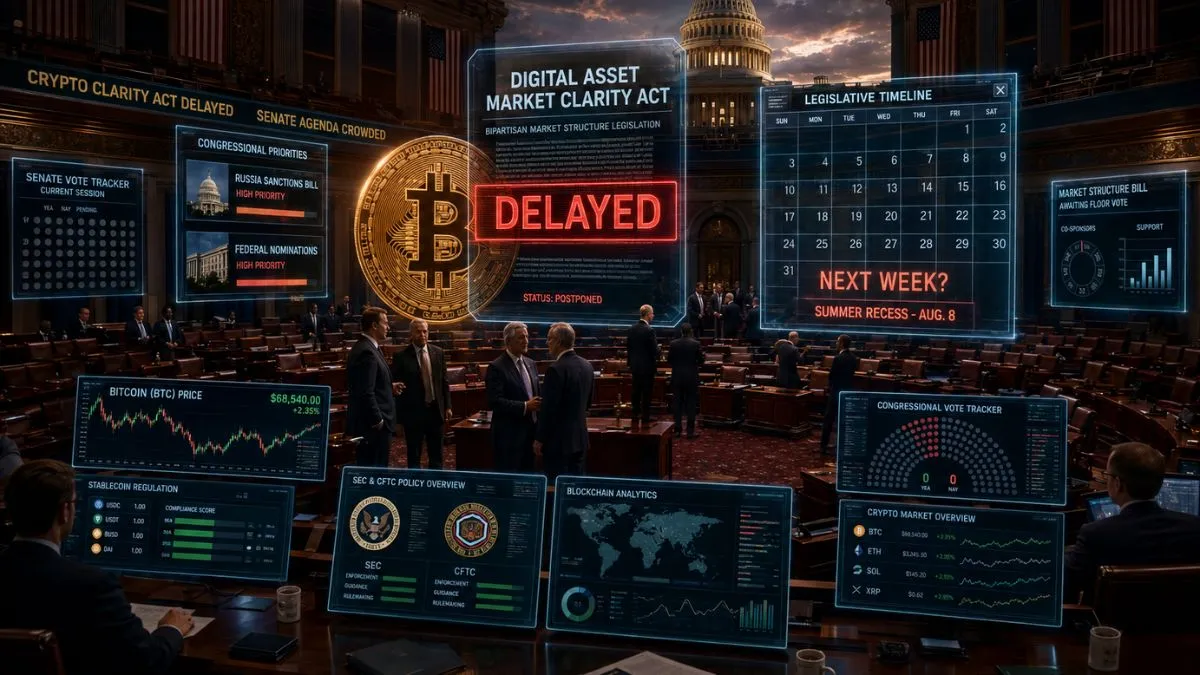
With just days before the August recess, the Digital Asset Market Clarity Act faces an uncertain path as Senate leadership prioritizes competing legislation and ethics provisions remain unresolved.

By Jane Doe
Published on Jul 28, 2026
 Cryptorah
Quick Take
- U.S. Senate delays Digital Asset Market Clarity Act to focus on Russian sanctions bill and federal nominations, pushing crypto regulation timeline into uncertainty
- Senate Majority Leader John Thune says chamber must "see where the votes are" on Clarity Act before August 8 recess, with competing priorities consuming limited floor time
- Major sticking point remains: contentious provision banning senior government officials, including President Trump, from backing crypto projects
- Industry faces narrowing legislative window — if bill doesn't advance before recess, best hope shifts to September floor time or chaotic lame-duck session after November elections
What Happened
The U.S. Senate has effectively shelved the Digital Asset Market Clarity Act — the crypto industry's flagship regulatory legislation — as Senate Majority Leader John Thune redirects the chamber's attention to a Russian sanctions package and a slate of federal nominations.
Thune began processing nominees on Monday and indicated the Senate would pivot to the Russia sanctions bill Tuesday night, triggering the arcane cloture process that governs Senate floor debates. This procedural framework involves mandatory waiting periods and sequential steps, and the chamber's rules typically restrict it to handling one contested bill at a time.
The sanctions legislation would impose penalties on Russian leadership and tariffs on trading partners. It has been dedicated to the memory of recently deceased Senator Lindsey Graham, who championed the measure. Graham's funeral this week will further occupy Senate attention Tuesday and Wednesday, splitting between Washington and South Carolina.
The practical result: the Clarity Act is unlikely to reach a floor vote before next week — the final days before the chamber's scheduled August 8 summer recess.
The Bill Still Isn't Ready
Even if floor time opened up immediately, the Clarity Act isn't prepared for a vote. Negotiations continue on the provision that has emerged as the legislation's most divisive element: the ban on senior government officials — explicitly including President Donald Trump — from participating in or endorsing crypto projects.
Thune's office confirmed to CoinDesk last week that the Russia legislation would take priority over crypto regulation. While the majority leader expressed hope that the chamber could address the Clarity Act before the break, he qualified that the leadership would need to "see where the votes are" — Senate shorthand for uncertain passage prospects.
Why It Matters
Industry's Regulatory Future at Stake
The delay represents more than a scheduling inconvenience. With major disagreements still unresolved at this late legislative stage, the probability that the Clarity Act becomes law in 2026 is narrowing measurably.
If this legislation fails to advance, the U.S. crypto industry's path to regulatory legitimacy shifts to three backup channels:
- The GENIUS Act implementation — the Guiding and Establishing National Innovation for U.S. Stablecoins Act, which has already progressed further through the legislative process
- Securities and Exchange Commission rulemaking — agency-level policy efforts that move independently of Congressional action
- Commodity Futures Trading Commission guidance — regulatory clarity through enforcement and interpretive releases rather than statute
None of these alternatives deliver the comprehensive market structure framework that the Clarity Act promised. The bill was designed to establish clear jurisdictional lines between the SEC and CFTC, define which digital assets qualify as securities versus commodities, and create registration pathways for crypto exchanges and custodians.
At this calendar juncture, every hour of Senate floor time is precious. Outstanding disagreements — especially the government ethics section — consume negotiating bandwidth and reduce the odds of a breakthrough before lawmakers scatter for the five-week recess.
The Timeline Crunch
What the Calendar Actually Looks Like
The Senate returns for a few weeks in September after the summer break. That represents the final chunk of regular legislative time before the political calendar takes over.
After the November midterm elections, Congress enters its lame-duck session — the period when defeated and retiring lawmakers serve out their final weeks until the next Congress convenes in January. Lame-duck sessions occasionally produce last-minute legislative deals in what can become chaotic rounds of negotiation, but they can just as easily freeze in political paralysis.
The industry's best-case scenario at this point may be initiating the cloture process just before the August recess — a procedural beachhead that could tee up a vote in September.
The Senate Has Always Been the Bottleneck
A similar version of the Clarity Act already cleared the House of Representatives. But the Senate has consistently functioned as the greater obstacle to crypto legislation.
This bill was initially stalled for months over the treatment of stablecoin yield — a debate that pitted the crypto sector against traditional banking interests. That impasse eventually resolved through a compromise that restricted stablecoin rewards programs to formats that wouldn't directly compete with yield-bearing bank deposits.
Once that hurdle cleared, the focus shifted to the current sticking point: crypto participation limits on government officials.
The Ethics Battle Over Presidential Crypto Holdings
Last week appeared to deliver a breakthrough when President Trump signaled he would accept provisions limiting his interactions with digital assets. White House officials characterized the constraints as historic and unprecedented ethics guardrails.
Democrats immediately countered that the restrictions didn't go far enough to address Trump's lucrative crypto business interests. The parties agreed to continue negotiations, but the gap remains unresolved.
Democrats opposed to the bill hosted a Monday event specifically focused on government ethics and the president's crypto activities, underscoring that the issue remains live and contentious.
Background: Trump's Crypto Interests
President Trump has publicly promoted various crypto projects and has financial ties to digital asset ventures. Critics argue that allowing a sitting president to maintain these connections while signing legislation that shapes the regulatory framework for those same assets creates an unacceptable conflict of interest. The Clarity Act's ethics provision attempts to draw a line, but Democrats contend the line isn't firm enough.
What's Next
If the Bill Clears the Senate
Even if the Clarity Act passes in the Senate, it must return to the House for another approval vote. Recent infighting among House Republicans has derailed action on other legislative priorities, adding another layer of uncertainty.
If both chambers approve the legislation, it heads to President Trump's desk. In recent weeks, Trump refused to sign an unrelated bipartisan housing bill, taking a public stand against signing any legislation until Congress sends him a voter-identification bill ahead of the midterm elections.
Trump has actively called for the Clarity Act to be completed, though it's unclear whether his voter-ID stance would block this bill as well. Under constitutional procedure, if the president takes no action for 10 days after receiving a bill, it automatically becomes law (unless Congress has adjourned, triggering a "pocket veto").
Things to Watch
- Senate floor schedule updates — Any signal that Thune will slot Clarity Act cloture before the recess
- Ethics provision negotiations — Whether Democrats and the White House bridge the gap on presidential crypto restrictions
- House Republican caucus dynamics — Internal party cohesion will determine whether a Senate-passed bill can clear the House
- Trump's legislative posture — Clarification on whether his voter-ID ultimatum applies to crypto legislation
- GENIUS Act progress — Stablecoin-specific regulation may advance independently and faster than comprehensive market structure reform
Alternative Regulatory Pathways
If the Clarity Act stalls completely, the SEC and CFTC will continue shaping crypto regulation through enforcement actions, interpretive guidance, and administrative rulemaking — a slower, less predictable process than statutory clarity, but the regulatory reality the industry has navigated for years.
Frequently Asked Questions
The Clarity Act is comprehensive legislation designed to establish clear regulatory jurisdiction over digital assets, defining which fall under SEC oversight (as securities) and which under CFTC authority (as commodities). It would create registration frameworks for crypto exchanges and custodians, aiming to provide the legal certainty the industry has sought for years.
Senate Majority Leader Thune has prioritized a Russian sanctions package and federal nominations over the Clarity Act. The Senate's procedural rules generally restrict it to handling one disputed bill at a time, and Senator Lindsey Graham's funeral this week further limits available floor time. Additionally, the bill still has unresolved disagreements on ethics provisions.
The most contentious section of the bill would ban senior government officials, including President Trump, from backing or participating in crypto projects. Trump recently indicated he would accept limits on his crypto interactions, but Democrats argue the restrictions don't adequately address his financial interests in digital asset ventures. The parties are still negotiating the specifics.
The timeline is increasingly uncertain. The Senate must pass the bill before or shortly after returning in September, then the House must approve it (potentially with another round of negotiations), and finally President Trump must sign it — or allow it to become law through 10 days of inaction. If the bill doesn't advance before the August 8 recess, realistically the best windows are September floor time or the post-election lame-duck session, pushing implementation into 2027 at the earliest.
The industry would rely on three alternative paths: continued implementation of the GENIUS Act (stablecoin-focused legislation), ongoing SEC rulemaking and enforcement, and CFTC guidance. These channels provide regulatory development but lack the comprehensive market structure framework the Clarity Act promised. The result would be a slower, more fragmented evolution of U.S. crypto regulation.
Source Notes
This report is based on reporting from CoinDesk regarding Senate floor scheduling, statements from Senate Majority Leader John Thune's office, and the legislative status of the Digital Asset Market Clarity Act as of the week preceding the Senate's August 2026 recess. All dates, procedural details, and negotiation status reflect information available in the original reporting.
Investment disclaimer: The content reflects the author’s personal views and current market conditions. Please conduct your own research before investing in cryptocurrencies, as neither the author nor the publication is responsible for any financial losses.
Ad Disclosure: This site may feature sponsored content and affiliate links. All advertisements are clearly labeled, and ad partners have no influence over our editorial content.

Related Articles

Coinbase Canada Pushes for Regulatory Clarity as It Eyes Derivatives and Tokenized Asset Expansion
Coinbase Canada's new CEO Eric Richmond outlines expansion plans into derivatives and tokenized assets while calling for permanent regulatory framework to replace temporary exemptions.
CFTC Warns Prediction Market Platforms Against Generic Event Contract Filings
The CFTC warns prediction market platforms against using template-based event contract filings, demanding detailed compliance information amid legal uncertainty.

XRP Price Prediction: AI Models See $4-$8 Target as Legal Overhang Lifts
ChatGPT AI predicts XRP could reach $4-$8 by end of 2026 as SEC lawsuit closure removes legal overhang, but current price at $1.02 suggests the harder test lies ahead.

Solana Flashes Three Technical Buy Signals as Traders Eye the $100 Level
Solana (SOL) is flashing three technical signals — a parallel channel breakout setup, a TD Sequential buy signal, and an MACD golden cross — that traders say could open a path toward $100. Here's what's confirmed, what's speculative, and what to watch.