

Telegram now faces legal fire on three fronts at once, as Australia sues over terror content
A Federal Court filing in Canberra accuses Telegram of ignoring years of complaints about extremist material — landing one day after Russia charged founder Pavel Durov with facilitating terrorism, and while French prosecutors separately pursue him.

By Jane Doe
Published on Jul 30, 2026
 Cryptorah
Quick take
- Australia's eSafety Commissioner filed civil penalty proceedings against Telegram in the Federal Court, alleging it failed to act on complaints about "pro-terror" content.
- A year-long eSafety probe found some flagged material stayed up for as long as three weeks, and that known footage from the 2019 Christchurch and 2022 Buffalo mass shootings went undetected before removal.
- Telegram could face fines of up to AUD $54.6 million (about $35.8 million).
- The filing lands a day after Russia's FSB charged founder Pavel Durov with facilitating terrorist activity; he's also under separate investigation in France since his 2024 arrest.
What happened
Australia's online safety regulator, the eSafety Commissioner, has opened civil penalty proceedings against Telegram in the Federal Court, arguing the messaging app — used by more than a billion people globally — breached its obligations under the country's Online Safety Act to deal with "pro-terror" content.
The regulator says a year-long investigation turned up a pattern of inaction: Telegram allegedly knew about unlawful material on its platform through user complaints but didn't remove it, and in some cases the flagged content stayed visible for as long as three weeks. eSafety also alleges the company failed to take adequate steps to stop repeat offenses, including shutting down the accounts, channels, and groups used to spread pro-terror material.
Perhaps the sharpest allegation: eSafety says Telegram failed to catch already-known extremist footage circulating on the platform, including video from the 2019 Christchurch mosque shootings and the 2022 mass shooting in Buffalo, New York — both of which were eventually taken down, but not before eSafety flagged the gap in detection.
Background: what is the Online Safety Act, and who is eSafety?
The source material identifies eSafety as Australia's online safety regulator and names the Online Safety Act as the law underpinning this case, but doesn't detail the Act's broader provisions. ⚠️ The raw content doesn't specify what other obligations the Act imposes on platforms beyond the terror-content duties described here — treat this filing as one enforcement action under a wider law, not the whole of it.
Why it matters
Reading between the filings
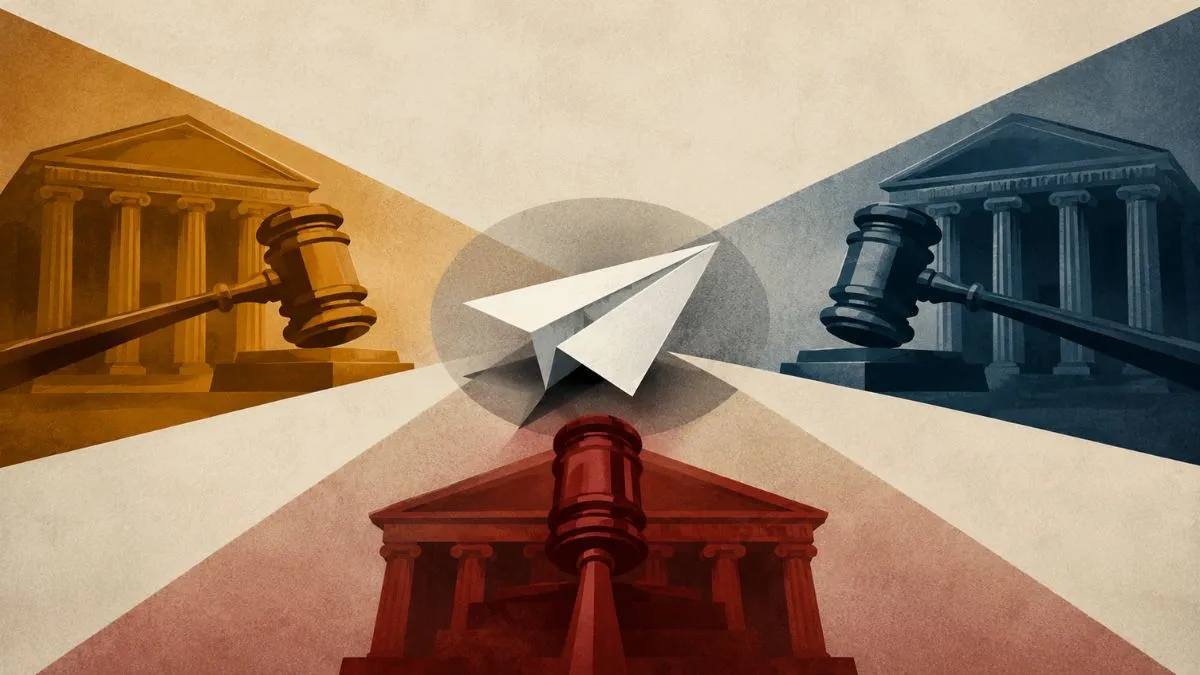
This is no longer an isolated regulatory dispute. Telegram is simultaneously facing an Australian civil case over moderation failures, a Russian criminal case against its founder over alleged terrorism facilitation, and an ongoing French investigation into Durov personally — three governments, three legal theories, one company. For a platform that has built its brand around resisting content takedowns and government pressure, the timing of the Australian filing landing a day after Russia's charges suggests Telegram's moderation practices are drawing convergent scrutiny well beyond any single jurisdiction's politics.
For the wider industry, the case tests how aggressively national regulators are willing to pursue platforms that operate at global scale but resist centralized content moderation — a model increasingly out of step with tightening online safety regimes.
The numbers
Methodology & sourcing notes
All figures above come directly from eSafety's allegations and statements as reported in the source article. "About one year" reflects the source's description of the investigation's length; it isn't given as an exact duration. The three-week figure is described as the longest reported delay, not an average across all flagged content. The AUD-to-USD conversion (A$54.6M ≈ US$35.8M) is as stated in the source, not independently recalculated here.
Market & platform reaction
Telegram has not issued a formal statement addressing the Australian proceedings. Its official X account instead posted a video captioned "freedom of expression" — a framing that echoes the company's long-standing position against centralized content takedowns. On the separate Russian charges, Telegram was similarly silent in official terms, posting an image of Durov making a profane gesture rather than a statement.
Durov has previously pushed back publicly on the broader regulatory trend. In an October 2025 post on X, he wrote that what was once meant as free information exchange is, in his view, being repurposed into a tool of control — a comment made in a separate context from the Australian filing but illustrative of his stance on regulatory pressure generally.
What's next / things to watch
- Federal Court process: The source confirms proceedings have been filed in Australia's Federal Court; it does not give a hearing date or expected timeline for resolution. ⚠️ Timing of any ruling or penalty is unknown from the available material.
- Durov's international wanted-list status: Russia's FSB has said it has begun procedures to place Durov on an international wanted list; whether that process concludes, and what it would mean practically given his location, isn't addressed in the source.
- The French investigation: Durov remains under investigation in France following charges including complicity in distributing illegal content; no update on that case's status beyond its existence is given here.
- Whether Telegram responds formally: So far, Telegram's public reactions to both the Australian and Russian actions have been symbolic social-media posts rather than statements — worth watching whether that changes as the Federal Court case proceeds.
FAQs
Why is Australia suing Telegram?
Australia's eSafety Commissioner alleges Telegram failed to remove "pro-terror" content despite user complaints, didn't adequately stop repeat violations, and failed to detect known extremist footage — breaching duties under the Online Safety Act.
How much could Telegram be fined?
eSafety is seeking penalties that could reach AUD $54.6 million, roughly $35.8 million USD, under Australia's online safety rules.
Is this connected to Pavel Durov's legal troubles in Russia and France?
Not directly as a single case, but they're converging in time. Russia's FSB charged Durov with facilitating terrorist activity one day before Australia's filing, alleging Telegram let extremist and Ukrainian intelligence-linked channels operate. Separately, Durov has faced a French investigation, including charges of complicity in distributing illegal content, since his August 2024 arrest.
Has Telegram responded to the lawsuit?
Not with an official statement, as of the source reporting. Its X account posted a video captioned "freedom of expression" in response to the Australian action, and a separate image of Durov in response to the Russian charges.
What content is at the center of the Australian case?
eSafety points to Telegram's alleged failure to detect and remove pro-terror material generally, and specifically cites footage from the 2019 Christchurch mosque shootings and the 2022 Buffalo mass shooting as examples of known extremist content that went undetected before eventual removal.
- eSafety Commissioner official statement, as cited in the source reporting (no direct URL provided in the source material).
- Related: "Pavel Durov says Telegram to roll out native Gram crypto wallet" — referenced in the source article; no URL provided.
- Durov's October 2025 post on X — referenced in the source article; no URL provided.
⚠️ The original source material referenced related articles by headline only, without direct hyperlinks — endnotes above reflect exactly what was provided.
Investment disclaimer: The content reflects the author’s personal views and current market conditions. Please conduct your own research before investing in cryptocurrencies, as neither the author nor the publication is responsible for any financial losses.
Ad Disclosure: This site may feature sponsored content and affiliate links. All advertisements are clearly labeled, and ad partners have no influence over our editorial content.

Related Articles

XRP Price Prediction: AI Models See $4-$8 Target as Legal Overhang Lifts
ChatGPT AI predicts XRP could reach $4-$8 by end of 2026 as SEC lawsuit closure removes legal overhang, but current price at $1.02 suggests the harder test lies ahead.

Fireplace Is Extinguished: Prediction Market Terminal Shuts Down 195 Days After Launch
Prediction markets terminal Fireplace is shutting down 195 days after launch, giving users until Sept 30 to withdraw funds — even after raising $1.5M and building for Polymarket and Kalshi.

CLARITY Act Push, Another Strategy Bitcoin Sale, and a Warning About Invisible Quantum Attacks
A recap of today's crypto news: the White House's push to pass the CLARITY Act by September, Strategy's latest Bitcoin sale to fund a stock buyback, and a warning about undetectable quantum-computing attacks on crypto wallets.

Standard Chartered: LINK Could Climb 25x to $200 if Tokenized Assets Hit $4T by 2028
Standard Chartered forecasts LINK could rise 25-fold to $200 by 2030 as tokenized real-world assets scale to $4 trillion, citing Chainlink's dominant oracle market position.