

Coldcard's Five-Year Randomness Bug: Why Auditors Missed a Silent Swap in the Wallet's Core Security Function
Kraken's chief security officer says the industry lacks a standard check that would have caught the flaw: verifying not just that a secure random-number generator exists in the code, but that it's the one actually running.

By Jane Doe
Published on Aug 3, 2026
 Cryptorah
Quick Take
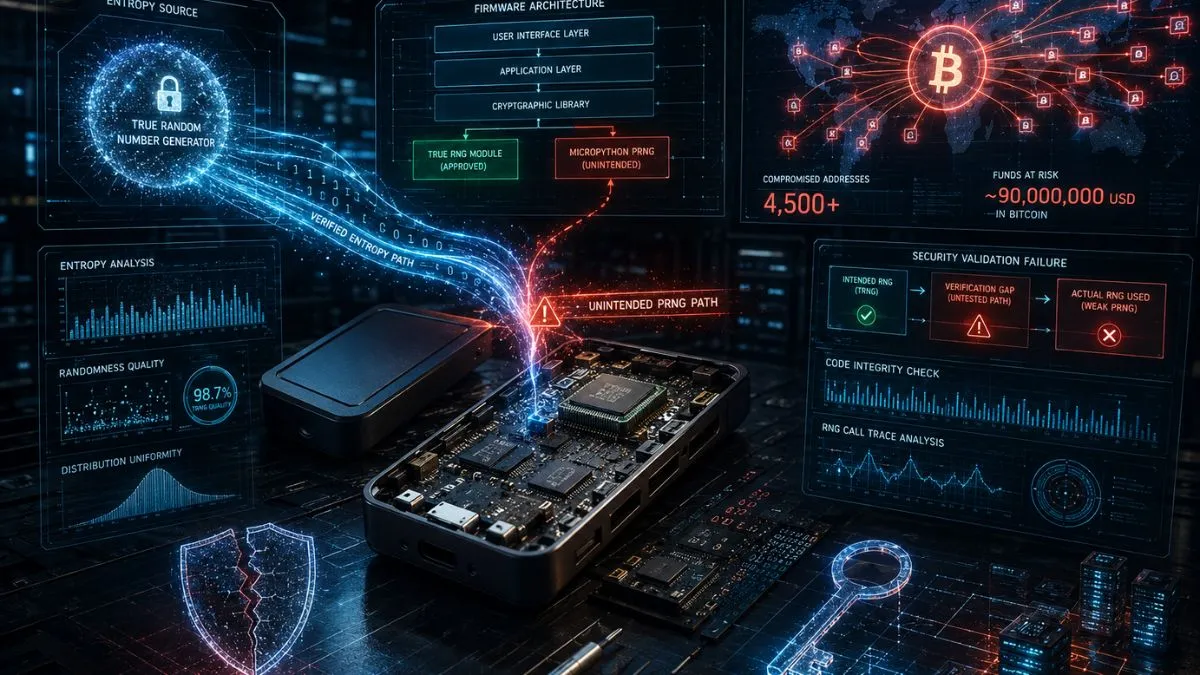
- A software flaw dating to March 2021 caused some Coldcard hardware wallets to generate seed phrases using a weaker MicroPython random-number generator instead of the device's intended true random number generator (TRNG).
- An ongoing attack believed to exploit this weakness has hit over 4,500 addresses and drained nearly $90 million in Bitcoin as of Sunday.
- Kraken CSO Nick Percoco says the bug slipped through because audits confirmed the secure TRNG code existed — not that production firmware actually called it — and wants industry-wide entropy-path verification.
- Coinkite (Coldcard's maker) has halted shipments, destroyed affected inventory, and is telling owners of affected devices not to dispose of them in case funds are recovered.
What Happened
On Thursday, Coldcard maker Coinkite disclosed that a flaw had existed in the device's seed-generation process since March 2021 — the point at which Coldcard reworked how it generates wallet seeds while integrating a new cryptographic library.
That migration had an unintended side effect: instead of routing seed creation through Coldcard's purpose-built true random number generator (TRNG), the process was silently redirected to a weaker random generator built into MicroPython, the firmware's scripting language. In its own postmortem, Coinkite described the situation bluntly — the bulk of randomness on the device was coming from a generator the team wasn't even aware was present in the codebase, while the carefully engineered TRNG code sat mostly unused, invoked only for less critical functions.
The bug is now believed to be behind an active, ongoing attack exploiting weak seed phrases produced by affected devices. Nick Percoco, chief security officer at Kraken, laid out the underlying audit failure in an X post on Sunday: code reviews could confirm the TRNG existed and functioned correctly, but nothing in the review process checked whether that TRNG was the component actually being called at seed-generation time.
Why It Matters
An Audit Blind Spot, Not Just a Coding Error
Percoco's core argument is that this wasn't simply a one-off mistake by one vendor — it exposes a structural gap in how hardware wallets get certified. He pointed to two frameworks that already exist elsewhere in security-critical hardware: NIST SP 800-90B, the U.S. government standard for designing, testing, and validating physical true random number generators, and BSI AIS-31, Germany's equivalent standard from its Federal Office for Information Security.
According to Percoco, hardware wallets have no real equivalent. Existing protections — Common Criteria certification on secure elements, CSPN certifications, and audits paid for by vendors themselves — don't force the kind of end-to-end verification that would catch a validated entropy source being silently swapped for a weaker one in production firmware.
Percoco called the incident a "wake-up call" for hardware-wallet makers broadly, not just Coinkite — the implication being that any vendor's audit process could have the same blind spot if it only checks for the presence of secure code rather than confirming it's the code path actually executing.
The Numbers
The figures below are the only quantified data points included in the source reporting, as of Sunday.
Timeline reconstructed from dates explicitly stated in the source reporting. Exact calendar date for "Thursday" and "Sunday" was not specified in the source.
Market Reaction
What's Next / Things to Watch
- Shipment halt in effect: Coldcard confirmed the vulnerability on Thursday and has since stopped all device shipments, destroying remaining units at its facilities that contained the affected firmware.
- Do not discard affected devices: Coinkite has explicitly told owners of affected hardware to hold onto their devices, saying they "may become essential if funds are recovered."
- Law enforcement coordination: Coinkite says its legal team will coordinate with law enforcement across multiple jurisdictions to support efforts to identify those responsible for the exploit.
- Industry standard-setting: Percoco's call for independent, standardized entropy-path verification (modeled on NIST SP 800-90B and BSI AIS-31) is a proposal, not a confirmed initiative — whether hardware wallet makers or a standards body act on it remains to be seen based on the source.
Background: What is a TRNG, and why does entropy matter for a hardware wallet?
A hardware wallet's seed phrase is the master key to all funds it controls, and that seed must be generated from a source of randomness (entropy) that's effectively impossible to predict or reproduce. A true random number generator (TRNG) typically draws entropy from physical, unpredictable processes (like electrical noise), while a pseudo-random number generator (PRNG) — such as the general-purpose one built into MicroPython referenced in this incident — produces output that is deterministic and can, in some cases, be far more predictable or lower-entropy than intended. If a wallet's seed is generated with weak or predictable randomness, an attacker who can guess or narrow down the possible seed values can potentially reconstruct a user's private keys and drain their funds — which is the mechanism believed to be behind the ongoing Coldcard attack described in this report.
Sourcing & methodology notes
All facts, figures, and quotes in this article are drawn solely from the supplied source article, which itself cites Nick Percoco's Sunday X post and Coinkite's own postmortem disclosure. No external data, pricing, or market figures were added. Two related headlines mentioned in the source ("Suspected 4th Coldcard attack wave sweeps 389 Bitcoin" and "Coldcard exploit sparks Bitcoin flight, 'bullish' crypto consolidation") are referenced by title only, as no URLs for them were provided in the source material.
FAQs
What exactly went wrong with Coldcard wallets?
Since March 2021, an unintended code path caused affected devices to generate wallet seed phrases using a weaker built-in MicroPython random number generator instead of Coldcard's dedicated true random number generator (TRNG), making seeds potentially easier to predict or reproduce.
How was the flaw discovered, and why did it take five years?
It went undetected because prior code audits confirmed that Coldcard's secure TRNG code existed and worked correctly, but did not verify that this was the code actually being executed during seed generation — a check Kraken's CSO says is missing industry-wide.
How much has been stolen, and is the attack still happening?
As of Sunday, the source reports that over 4,500 addresses had been impacted and nearly $90 million in Bitcoin drained, describing the attack as ongoing.
What should Coldcard owners do with an affected device?
Coinkite has advised against disposing of affected devices, saying they may be needed if funds are recovered. The source does not include further device-specific remediation steps such as reflashing or migration instructions.
Is Coldcard still shipping devices?
No — according to the source, Coldcard halted all device shipments after confirming the vulnerability on Thursday and destroyed remaining inventory containing the affected firmware.
Investment disclaimer: The content reflects the author’s personal views and current market conditions. Please conduct your own research before investing in cryptocurrencies, as neither the author nor the publication is responsible for any financial losses.
Ad Disclosure: This site may feature sponsored content and affiliate links. All advertisements are clearly labeled, and ad partners have no influence over our editorial content.

Related Articles
XRP Price Prediction: AI Models See $4-$8 Target as Legal Overhang Lifts
ChatGPT AI predicts XRP could reach $4-$8 by end of 2026 as SEC lawsuit closure removes legal overhang, but current price at $1.02 suggests the harder test lies ahead.
Fireplace Is Extinguished: Prediction Market Terminal Shuts Down 195 Days After Launch
Prediction markets terminal Fireplace is shutting down 195 days after launch, giving users until Sept 30 to withdraw funds — even after raising $1.5M and building for Polymarket and Kalshi.
CLARITY Act Push, Another Strategy Bitcoin Sale, and a Warning About Invisible Quantum Attacks
A recap of today's crypto news: the White House's push to pass the CLARITY Act by September, Strategy's latest Bitcoin sale to fund a stock buyback, and a warning about undetectable quantum-computing attacks on crypto wallets.

Standard Chartered: LINK Could Climb 25x to $200 if Tokenized Assets Hit $4T by 2028
Standard Chartered forecasts LINK could rise 25-fold to $200 by 2030 as tokenized real-world assets scale to $4 trillion, citing Chainlink's dominant oracle market position.