

Grayscale CEO Files to Sell Entire Pre-Conversion XRP Trust Stake as Fund Shrinks 51%
Peter Mintzberg's $53K Form 144 filing reveals third insider exit from GXRP amid sharp valuation drop and outflows

By Jane Doe
Published on Jul 30, 2026
 Cryptorah
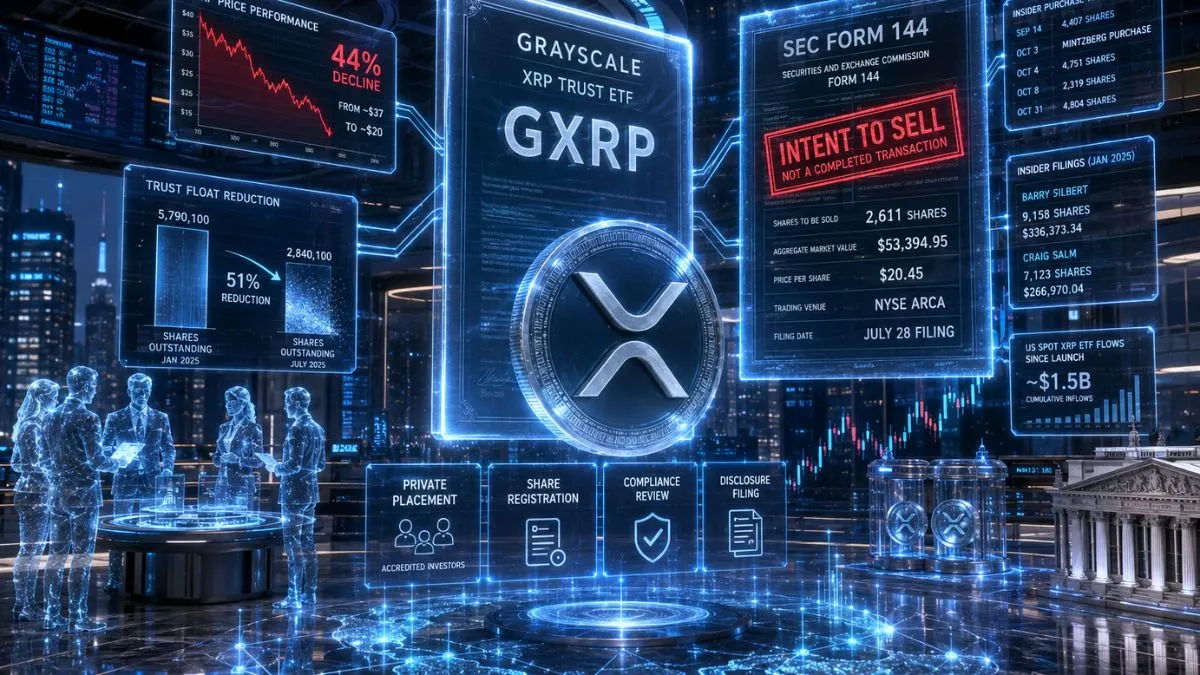
Quick Take
- Grayscale CEO Peter Mintzberg filed to sell all 2,611 GXRP shares purchased in October 2024, seven weeks into his tenure
- The filing values shares at $20.45 each, down 44% from January insider filings that showed $36-37 per share
- GXRP's outstanding shares have halved from 5.79 million to 2.84 million in six months, while competing XRP ETFs manage significantly larger assets
- All three Grayscale insiders who filed on GXRP bought within the same seven-week window in fall 2024, before the fund converted to an ETF
What Happened
Peter Mintzberg, CEO of Grayscale Investments, filed a Form 144 notice with the SEC on July 28, 2026, signaling his intent to sell 2,611 shares of the Grayscale XRP Trust (GXRP). The filing represents the entirety of his position in the fund, which he acquired through a private transaction directly with the issuer on October 3, 2024.
The notice values the transaction at $53,394.95 in aggregate, pricing each share at $20.45. Cantor Fitzgerald is listed as the broker handling the sale, with NYSE Arca designated as the trading venue. Importantly, a Form 144 filing indicates an intention to sell restricted securities but does not confirm that the transaction has been completed.
Mintzberg reported no prior sales of GXRP in the three months preceding the filing, and the shares were purchased with cash rather than acquired through equity compensation or other non-cash arrangements.
The Insider Transaction Pattern
Mintzberg is the third Grayscale insider to file a Form 144 on GXRP shares, following two January 2026 filings from other senior executives. The pattern reveals a coordinated acquisition window in late 2024, when the fund still operated as a private placement vehicle for accredited investors.
Timeline of Insider Acquisitions
| Insider | Role | Purchase Date(s) | Shares Acquired | Filing Date | Price per Share (Filing) |
|---|---|---|---|---|---|
| Barry Silbert | DCG Founder, 10% Stockholder | Sept 14, Oct 4, 2024 | 9,158 (4,407 + 4,751) | Jan 26, 2026 | $36.73 |
| Craig Salm | Chief Legal Officer | Oct 8, Oct 31, 2024 | 7,123 (2,319 + 4,804) | Jan 26, 2026 | $37.48 |
| Peter Mintzberg | CEO | Oct 3, 2024 | 2,611 | July 28, 2026 | $20.45 |
All three insiders completed their purchases between September 14 and October 31, 2024. Mintzberg had assumed the CEO role on August 15, 2024, making his October 3 purchase a move executed just seven weeks into his tenure at the firm. He joined from Goldman Sachs, bringing traditional finance credentials to Grayscale's leadership.
Barry Silbert, founder of Grayscale's parent company Digital Currency Group, held his shares through a Roth IRA and executed the transaction via Capital Institutional Services. His filing listed OTCQX as the trading venue. Craig Salm, Grayscale's top legal executive, routed his sale through Canaccord Genuity and, like Mintzberg, designated NYSE Arca as the venue.
The Numbers Behind the Sale
GXRP Share Price: January vs July Filings
The implied share price in Mintzberg's July filing shows a 44% decline from January valuations.
The drop from roughly $37 per share in January to $20.45 in July represents a sharp contraction in the fund's implied per-share value over a six-month span. This decline occurred as the broader XRP market experienced significant volatility and as the newly converted ETF faced competitive pressure from rival products.
Trust Float Collapses by Half
Beyond individual insider transactions, the most striking change in GXRP's structure is the dramatic reduction in outstanding shares. The January filings from Silbert and Salm both listed 5,790,100 shares outstanding. Mintzberg's July filing shows just 2,840,100 shares—a reduction of 2,950,000 shares, or 51%.
At the current $20.45 price per share, the remaining share count values the entire trust near $58 million in assets under management. This positions GXRP well behind category leaders: Bitwise's XRP ETF holds close to $500 million, while Canary's XRPC fund manages just under $470 million.
The fund's history as a private placement vehicle provides context for this contraction. By its first anniversary in September 2025, the trust held close to $17 million across 301,500 shares, servicing accredited investors exclusively. Grayscale converted the trust to a publicly traded ETF and uplisted it to NYSE Arca on November 24, 2025—eleven days after the first U.S. spot XRP ETF launched on Nasdaq on November 13, 2025.
The sharp reduction in outstanding shares since the ETF conversion suggests either significant redemptions, share buybacks, or structural adjustments related to the transition from private to public markets.
Market Context and XRP Price Action
The insider filings and fund contraction occurred against a backdrop of extreme volatility in XRP itself. As of July 30, 2026, XRP traded at $1.07, representing a 70.5% decline from its recent high of $3.65 set on July 17, 2025.
Across the broader category of U.S. spot XRP ETFs, flows have largely stagnated. According to the source data, seven of the ten business days leading up to July 19, 2026 recorded zero net flows across all XRP funds. Since launch, the category has attracted close to $1.5 billion in cumulative inflows, but momentum appears to have slowed considerably.
Why It Matters
Insider Selling in Nascent Crypto ETFs Raises Questions
Insider transactions are routine in public markets, but the timing and scale of Grayscale's executive moves on GXRP merit attention. All three insiders—CEO, Chief Legal Officer, and the parent company's founder—purchased shares in the same narrow window when the fund was still private. Their subsequent filings to sell, combined with a 44% valuation drop and a 51% contraction in outstanding shares, paint a picture of a struggling product in a competitive landscape.
For investors evaluating XRP ETF options, GXRP's underperformance relative to Bitwise and Canary funds suggests that brand recognition and early-mover advantage do not automatically translate to market dominance in crypto ETFs. Grayscale's Bitcoin and Ethereum trusts enjoyed monopolistic positions for years before ETF conversions, but the XRP market launched with immediate competition.
The stagnation in category-wide flows also signals that institutional and retail appetite for XRP exposure via ETFs may be cooling, particularly as XRP's price has retreated sharply from its mid-2025 highs. Zero net flow days dominating recent trading sessions indicate a lack of conviction among market participants.
What's Next
The filing of a Form 144 does not guarantee that a sale will occur, nor does it specify the exact timing if it does. Mintzberg's notice establishes intent and regulatory compliance, but market conditions, company policies, or strategic considerations could delay or prevent execution.
Investors watching GXRP should monitor whether:
- Mintzberg completes the sale and whether additional insider filings follow
- The fund's outstanding share count continues to contract or stabilizes
- XRP ETF flows resume or remain muted in the coming months
- GXRP's management announces structural changes, fee adjustments, or marketing initiatives to compete with larger rivals
- XRP's price action influences redemption behavior and fund performance
Given the fund's current trajectory, Grayscale faces pressure to demonstrate value to shareholders and differentiate GXRP in a crowded field. The firm's track record with GBTC and ETHE conversions shows it can navigate complex transitions, but those products lacked direct competition at launch.
Technical Context: What Is a Form 144 Filing?
A Form 144 is filed with the SEC when an insider, affiliate, or holder of restricted securities intends to sell shares under Rule 144. The rule allows the sale of restricted or control securities in the public market, subject to certain conditions including holding periods, volume limitations, and proper filing.
The form must be filed concurrently with the placement of the sell order if the sale involves more than 5,000 shares or exceeds $50,000 in value during any three-month period. Filing a Form 144 does not obligate the seller to execute the transaction, and sales can be withdrawn or delayed. The form is primarily a regulatory disclosure mechanism to inform the market of potential insider selling activity.
Frequently Asked Questions
Why did Grayscale's CEO buy XRP Trust shares in October 2024?
Peter Mintzberg purchased 2,611 shares on October 3, 2024, seven weeks after becoming CEO. The shares were bought through a private transaction directly with the issuer at a time when the trust operated as a private placement for accredited investors. The filing does not disclose his motivation, but executive purchases of company products can signal confidence or serve as part of compensation arrangements.
Does a Form 144 filing mean the shares have already been sold?
No. A Form 144 filing indicates an intention to sell and satisfies SEC disclosure requirements, but it does not confirm that the transaction has been completed. The sale may occur shortly after filing, be delayed, or not happen at all depending on market conditions and the seller's decisions.
Why has GXRP's share count dropped 51% since January?
The source material does not provide explicit detail on the mechanism behind the reduction from 5.79 million shares to 2.84 million. Possible explanations include investor redemptions following the ETF conversion, corporate buybacks, or structural adjustments related to the transition from a private trust to a publicly traded ETF. The sharp contraction suggests significant outflows or share cancellations.
How does GXRP compare to competing XRP ETFs?
As of the filing date, GXRP held approximately $58 million in assets under management. This is substantially smaller than Bitwise's XRP ETF, which manages close to $500 million, and Canary's XRPC fund at just under $470 million. GXRP launched later than some competitors and has struggled to attract flows in a stagnant market environment.
What does this mean for XRP's price?
Insider selling from a single ETF is unlikely to directly impact XRP's market price, as the volumes involved are small relative to XRP's overall trading activity. However, the broader context—stagnant ETF flows, fund contraction, and XRP's 70.5% decline from recent highs—reflects weak sentiment and reduced institutional interest in XRP exposure via U.S. ETFs.
Sources & Methodology
All figures, dates, share counts, and prices cited in this report are derived exclusively from the provided source material describing SEC Form 144 filings for Grayscale XRP Trust insiders Peter Mintzberg, Barry Silbert, and Craig Salm. No external price data, exchange information, or supplementary sources were used. Share price comparisons and percentage calculations are based on the implied prices stated in the filings.
Investment disclaimer: The content reflects the author’s personal views and current market conditions. Please conduct your own research before investing in cryptocurrencies, as neither the author nor the publication is responsible for any financial losses.
Ad Disclosure: This site may feature sponsored content and affiliate links. All advertisements are clearly labeled, and ad partners have no influence over our editorial content.

Related Articles

Solana Flashes Three Technical Buy Signals as Traders Eye the $100 Level
Solana (SOL) is flashing three technical signals — a parallel channel breakout setup, a TD Sequential buy signal, and an MACD golden cross — that traders say could open a path toward $100. Here's what's confirmed, what's speculative, and what to watch.

Bitcoin Holds Above $65K as Bitway, WLD and PUMP Lead an Altcoin Sprint
Bitcoin holds above $65K while Bitway (BTW), WLD, and PUMP post double-digit daily gains; a look at the week's volatility and what's driving the altcoin moves.

Ethereum MEV-Bot Hacker Turns $7.7M Heist Into a $505K Trading Loss
The hacker behind the $7.7M jaredfromsubway.eth MEV bot exploit sold ETH after the attack, then bought back higher — booking a $505,000 trading loss on top of the stolen funds.

Pi Network Token Surges 15% as Bitcoin Tests $65K Resistance
Pi Network's PI token leads altcoin gains with a 15% surge while Bitcoin attempts to reclaim $65,000 after bouncing from monthly lows near $62,200.