

Korean Police Crack Down on $8.6M XRP Staking Scam as Token Holds Ground
Three arrests made in fake investment scheme targeting 71 victims while XRP trades sideways near $1.08

By Jane Doe
Published on Jul 30, 2026
 Cryptorah
Quick Take
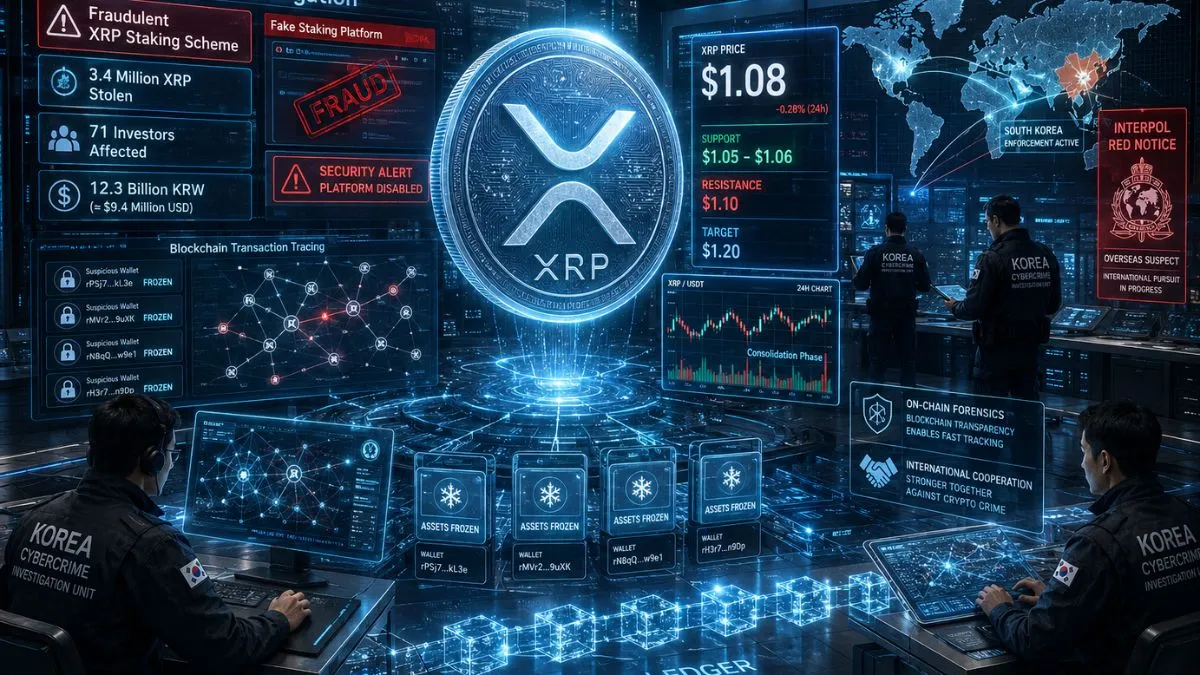
- Seoul police arrested three suspects in a fraudulent XRP staking operation that stole 3.4 million XRP (approximately $3.7 million USD at current prices, 12.3 billion won)
- The scheme promised monthly returns of 1.5%-1.8% through a fake website and social media promotion
- Authorities froze suspect wallets within three days using blockchain tracking; a fourth suspect remains at large under Interpol Red Notice
- XRP price remained stable around $1.08, with traders viewing the case as isolated fraud rather than a network vulnerability
What Happened
The Seoul Metropolitan Police Agency announced the arrest of three individuals connected to a sophisticated cryptocurrency fraud operation that defrauded 71 investors of 3.4 million XRP tokens valued at approximately 12.3 billion Korean won.
The perpetrators operated through a website called Fxrpntwork.com, which marketed itself as a legitimate XRP staking platform. The fraudulent service promised investors consistent monthly returns ranging from 1.5% to 1.8% on their XRP holdings—a claim designed to exploit retail investors' desire for passive income from cryptocurrency assets.
The scheme relied on a multi-channel marketing approach that included blog posts, online articles, and YouTube videos to build credibility and attract victims. This combination of content marketing tactics mirrors patterns seen in other recent crypto scams that leverage social proof and educational content to appear legitimate.
The Investigation
Law enforcement moved swiftly once the first complaint was filed. Investigators utilized blockchain analysis tools to trace the movement of stolen XRP on-chain, successfully freezing the suspects' wallets within just three days of receiving the initial report.
The alleged ringleader of the operation was apprehended upon returning to South Korea, suggesting the individual had attempted to leave the country following the scam's execution. Two accomplices were captured while attempting to flee within South Korean borders.
A fourth suspect remains at large outside the country, with authorities issuing an Interpol Red Notice—an international request for law enforcement agencies worldwide to locate and provisionally arrest the individual pending extradition.
The Numbers
Note on staking yield context
XRP does not use a traditional proof-of-stake mechanism, so native staking in the conventional sense doesn't exist for XRP. Legitimate platforms may offer yield through lending or other mechanisms, but returns of 1.5-1.8% monthly (18-21.6% annually) far exceed typical risk-adjusted yields in the cryptocurrency lending market, which should have been a red flag for potential investors.
Market Reaction
XRP price traded around $1.08 following news of the arrests, slipping modestly over the 24-hour period but avoiding any sharp selloff. The token found intraday support near $1.05 and reached a high around $1.09, indicating market participants largely compartmentalized the fraud case from the asset's broader fundamentals.
According to the source material, traders interpreted the incident as an isolated criminal operation rather than a systemic issue with the XRP Ledger or network infrastructure. This distinction is important: the fraud involved a fake third-party website claiming to offer staking services, not a vulnerability in XRP's underlying protocol.
The narrow trading range between $1.05 and $1.10 suggests consolidation, with the source noting that sellers currently maintain an advantage in near-term price action. Initial resistance sits at $1.08, with $1.10 representing the first significant barrier that would need to be overcome for upward momentum.
Price Scenarios Outlined in Source
The source material presented three potential scenarios for XRP price movement:
- Bull case: XRP reclaims $1.10 on strong volume, opening a path toward $1.20 (an approximately 11% gain from current levels)
- Base case: Sideways trading between $1.05 and $1.10 as the market awaits fresh catalysts
- Bear case: Breaking below $1.05 support could expose the psychological $1.00 level
The analysis emphasized that XRP remains more sensitive to broader macroeconomic conditions and overall risk appetite in markets than to isolated enforcement actions like this fraud case.
Why It Matters
This case illustrates several important dynamics in the evolving relationship between cryptocurrency markets and law enforcement:
Blockchain Transparency as an Investigative Tool
The three-day turnaround from initial complaint to wallet freeze demonstrates how blockchain's transparent ledger can work in favor of law enforcement. Unlike traditional financial fraud where tracing funds through shell companies and offshore accounts can take months or years, on-chain movements of XRP were visible and traceable in real-time. This represents a significant advantage for authorities investigating crypto-related crimes.
South Korea's Hardening Stance
The Seoul Metropolitan Police Agency's swift action reflects South Korea's increasingly aggressive posture toward cryptocurrency fraud. As one of the world's most active crypto markets, South Korea has faced repeated waves of scams targeting retail investors. This case signals that authorities are building both the technical capability and institutional will to pursue such operations.
The source material specifically noted that investigators continue to pursue scams that target retail investors through fake investment platforms, suggesting this is part of a broader enforcement campaign rather than an isolated action.
Market Resilience to Enforcement News
The muted price reaction to the arrests indicates growing market sophistication in distinguishing between protocol-level issues and third-party fraud. In earlier years of cryptocurrency markets, any negative headlines—even those unrelated to a token's fundamental technology—could trigger panic selling. The stability shown by XRP during this news cycle suggests investors are becoming more discerning.
What's Next
Several factors will determine how this case unfolds and what precedents it sets:
The Fourth Suspect
With an Interpol Red Notice active, the international manhunt for the fourth suspect will test cross-border law enforcement cooperation in crypto cases. The outcome could influence how easily future scammers believe they can evade prosecution by fleeing to jurisdictions with weaker crypto enforcement.
Asset Recovery
While authorities froze the suspects' wallets, the source material does not specify whether all 3.4 million stolen XRP was recovered or if some funds were already moved or laundered. The success or failure of victim reimbursement efforts will be watched closely by both investors and other potential fraud targets.
Regional Enforcement Patterns
The source noted that "market sentiment could change if similar enforcement actions increase across the region." A wave of copycat crackdowns in other Asian jurisdictions could create short-term volatility for XRP and other assets commonly targeted in staking scams, even if the enforcement itself is fundamentally positive for long-term market health.
Price Movement Catalysts
According to the source, XRP's near-term price trajectory hinges more on macroeconomic factors and risk appetite than on this specific case. Traders are waiting for fresh catalysts to break the current consolidation pattern. A move above $1.10 on convincing volume would be needed to reopen the path toward $1.20, while loss of the $1.05 support level could trigger testing of the $1.00 psychological threshold.
FAQs
Does XRP actually support staking?
No, not in the traditional sense. XRP uses a consensus protocol rather than proof-of-stake, so native staking as it exists for cryptocurrencies like Ethereum or Cardano is not available. Any platform claiming to offer "XRP staking" is typically providing lending, yield farming, or other services—or in cases like this, committing fraud.
How did police freeze the wallets so quickly?
The source indicates investigators used blockchain tracking to trace the stolen XRP on-chain. While the article doesn't specify the exact mechanism, freezing likely involved identifying the wallets holding the stolen funds and working with exchanges or custodians where those wallets attempted to cash out or transfer assets.
Is this type of scam common in South Korea?
The source material notes that South Korean authorities continue to pursue scams targeting retail investors through fake investment platforms, suggesting this is part of a pattern rather than an isolated incident. South Korea's high cryptocurrency adoption rate makes it an attractive target for fraudsters.
Will victims get their XRP back?
The source confirms that authorities froze the suspects' wallets but does not provide information about whether full asset recovery was achieved or when/if victims will be reimbursed. This typically depends on how much of the stolen cryptocurrency was successfully seized versus already laundered or spent.
Should I be concerned about XRP's security after this news?
No. This was a third-party scam using a fake website, not a vulnerability in the XRP Ledger itself. The source notes that traders viewed the incident as an isolated criminal case rather than a network issue, which is why XRP price remained relatively stable following the news.
Source Notes
This report is derived entirely from the provided source material. No external data sources, price feeds, or supplementary research were consulted. All figures, quotes from authorities, and price levels reflect information contained in the original article.
Investment disclaimer: The content reflects the author’s personal views and current market conditions. Please conduct your own research before investing in cryptocurrencies, as neither the author nor the publication is responsible for any financial losses.
Ad Disclosure: This site may feature sponsored content and affiliate links. All advertisements are clearly labeled, and ad partners have no influence over our editorial content.

Related Articles
XRP Price Prediction: AI Models See $4-$8 Target as Legal Overhang Lifts
ChatGPT AI predicts XRP could reach $4-$8 by end of 2026 as SEC lawsuit closure removes legal overhang, but current price at $1.02 suggests the harder test lies ahead.

Fireplace Is Extinguished: Prediction Market Terminal Shuts Down 195 Days After Launch
Prediction markets terminal Fireplace is shutting down 195 days after launch, giving users until Sept 30 to withdraw funds — even after raising $1.5M and building for Polymarket and Kalshi.

CLARITY Act Push, Another Strategy Bitcoin Sale, and a Warning About Invisible Quantum Attacks
A recap of today's crypto news: the White House's push to pass the CLARITY Act by September, Strategy's latest Bitcoin sale to fund a stock buyback, and a warning about undetectable quantum-computing attacks on crypto wallets.

Standard Chartered: LINK Could Climb 25x to $200 if Tokenized Assets Hit $4T by 2028
Standard Chartered forecasts LINK could rise 25-fold to $200 by 2030 as tokenized real-world assets scale to $4 trillion, citing Chainlink's dominant oracle market position.