

South Korea Moves Toward Unified Crypto Framework as Tax Repeal Debate Intensifies
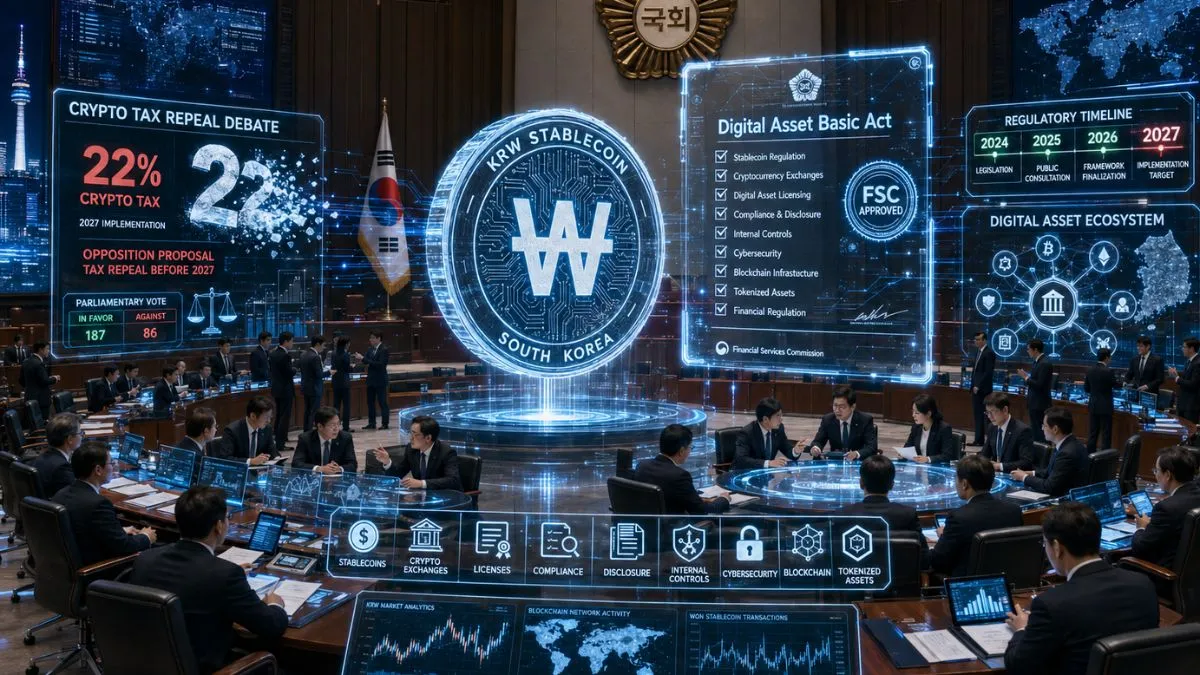
Financial regulators plan a consolidated Digital Asset Basic Act while opposition lawmakers advance legislation to abolish the 22% cryptocurrency income tax before its 2027 implementation.

By Jane Doe
Published on Jul 29, 2026
 Cryptorah
Quick Take
- South Korea's Financial Services Commission (FSC) intends to draft a consolidated Digital Asset Basic Act covering stablecoin rules, exchange requirements, and market oversight.
- Ten separate digital asset bills already sit in Parliament; disagreements over bank ownership of won-backed stablecoins and exchange ownership limits remain unresolved.
- Opposition lawmakers have introduced a bill to scrap the 22% crypto income tax scheduled for January 1, 2027, arguing it unfairly targets crypto holders while most stock investors remain exempt.
- A citizen petition with over 50,000 signatures backing the tax repeal is also awaiting committee review, though neither subcommittee has been fully constituted yet.
What Happened
South Korea's Financial Services Commission informed the National Assembly this week that it plans to introduce a unified Digital Asset Basic Act in collaboration with the ruling Democratic Party. The proposed legislation would consolidate regulatory standards for stablecoin issuance and circulation, digital asset business operations, exchange licensing, disclosure requirements, internal control frameworks, and system resilience benchmarks.
According to a report from Edaily published Wednesday, the FSC delivered the update ahead of a scheduled policy briefing. The move comes after months of legislative gridlock, with ten separate digital asset and stablecoin bills currently stalled in Parliament due to disagreements among lawmakers and industry stakeholders.
Key Sticking Points in the Draft Framework
Two major disputes continue to block consensus. First, whether won-denominated stablecoin issuers must be majority-owned by banks—a provision that would effectively hand control to traditional financial institutions and limit fintech participation. Second, whether ownership concentration limits should apply to major cryptocurrency exchanges, potentially forcing structural changes at dominant platforms.
The FSC has not yet announced a timeline for when the consolidated bill will be formally introduced or how it will navigate these contentious issues.
Opposition Pushes to Abolish Crypto Income Tax
Separately, the National Assembly's Finance and Economic Planning Committee was scheduled Wednesday to table an opposition bill that would eliminate South Korea's crypto income tax entirely before it takes effect on January 1, 2027. The Income Tax Act amendment was introduced on March 19 by People Power Party lawmaker Song Eon-seok and seeks to delete the provision that taxes income from transferring or lending digital assets.
Once tabled, the bill is expected to move to the committee's tax subcommittee for detailed review. A parallel citizen petition with more than 50,000 signatures is also set to go before a petitions subcommittee. However, Edaily reports that neither subcommittee has been fully constituted, and no review dates have been set.
Why It Matters
South Korea's regulatory uncertainty has left the country's vibrant cryptocurrency market in legal limbo. A consolidated government-backed bill could provide a baseline framework for negotiations and help break the legislative logjam. Without clear stablecoin rules, domestic issuers face operational ambiguity, while exchanges lack consistent compliance standards.
The ownership disputes are not merely technical. Requiring bank majority ownership of stablecoin issuers would entrench incumbents and potentially stifle innovation from fintech startups and blockchain-native companies. Similarly, ownership caps on exchanges could force restructuring at major platforms, affecting liquidity, user access, and market stability.
The Tax Debate Reflects Broader Fairness Concerns
The crypto income tax has become a flashpoint. The government and ruling Democratic Party argue that taxation is necessary for fairness and revenue generation. The opposition People Power Party counters that most ordinary stock investors in South Korea remain exempt from capital gains taxes, making it inequitable to single out cryptocurrency holders for a 20% tax plus 2% local levy on annual gains exceeding 2.5 million won (approximately $1,700).
On May 7, the Finance Ministry reaffirmed that the tax would proceed as scheduled after repeated delays. The opposition's repeal effort, combined with significant public pressure reflected in the petition, sets up a high-stakes political fight over whether the tax will actually be implemented.
The Numbers
Tax Structure Breakdown
| Component | Rate | Details |
|---|---|---|
| National Income Tax | 20% | Applied to annual crypto income above ₩2.5M |
| Local Income Tax | 2% | Additional levy on top of national tax |
| Total Effective Rate | 22% | Combined tax burden on qualifying gains |
| Implementation Date | Jan 1, 2027 | If not repealed or further delayed |
Background: Why the Tax Was Delayed
The crypto income tax was originally scheduled to take effect earlier but has been repeatedly delayed due to political pushback, industry lobbying, and concerns about market readiness. The Finance Ministry's May 7 statement marked the government's firmest commitment yet to proceed with the 2027 implementation date.
What's Next
Legislative Process for the Consolidated Bill
The FSC's drafting timeline remains unspecified. Once introduced, the consolidated Digital Asset Basic Act will need to reconcile competing interests on stablecoin ownership and exchange concentration limits. Given that ten bills are already pending, the consolidated proposal may serve as a negotiating baseline, but passage is far from certain without compromise on the core disputes.
Tax Repeal Timeline
The opposition's tax repeal bill is expected to be referred to the Finance and Economic Planning Committee's tax subcommittee for detailed consideration. The citizen petition will go before a petitions subcommittee. However, neither subcommittee has been fully constituted, meaning no review dates are currently scheduled.
Even if the opposition succeeds in advancing the repeal bill through committee, it would still require a floor vote in the National Assembly. With the ruling Democratic Party supporting the tax and holding significant seats, passage is uncertain. The political dynamic may shift depending on public pressure, market conditions, and whether the government perceives revenue or fairness benefits from the tax.
Industry and Market Response
South Korea is home to one of the world's most active retail crypto trading markets. Regulatory clarity on stablecoins and exchanges would affect major platforms and could influence whether global stablecoin issuers enter the Korean market. The tax debate will likely intensify as the 2027 deadline approaches, with exchanges, investors, and advocacy groups lobbying lawmakers and mobilizing public opinion.
Frequently Asked Questions
When will South Korea's crypto income tax take effect?
The crypto income tax is currently scheduled to take effect on January 1, 2027. It will impose a 20% national tax plus a 2% local tax on annual cryptocurrency income exceeding 2.5 million won (approximately $1,700). The opposition is attempting to repeal the tax before implementation, but the outcome remains uncertain.
What is the Digital Asset Basic Act?
The Digital Asset Basic Act is a proposed consolidated bill that South Korea's Financial Services Commission plans to draft with the ruling Democratic Party. It would establish regulatory standards for stablecoin issuance, digital asset business operations, exchange licensing, disclosures, internal controls, and system resilience. The FSC has not yet announced a formal introduction date.
Why are there disputes over stablecoin ownership?
One major dispute centers on whether won-denominated stablecoin issuers should be required to have majority bank ownership. Proponents argue this would ensure financial stability and regulatory oversight, while critics contend it would exclude fintech startups and blockchain-native companies, limiting competition and innovation.
How does the crypto tax compare to stock taxes in South Korea?
The opposition argues that most ordinary stock investors in South Korea remain exempt from capital gains taxes, making the 22% crypto tax inequitable. The government and ruling party counter that taxation is necessary for fairness and revenue generation, and that crypto income should be treated similarly to other investment income.
What happens to the ten pending digital asset bills?
Ten separate digital asset and stablecoin bills are currently pending in South Korea's Parliament. The FSC's consolidated bill is intended to provide a unified framework that could serve as a baseline for negotiations. Whether the existing bills will be incorporated, replaced, or remain separate depends on legislative negotiations and political consensus.
Sources
- Edaily report, published Wednesday (referenced in source content as primary reporting outlet for FSC policy briefing and tax bill developments)
Investment disclaimer: The content reflects the author’s personal views and current market conditions. Please conduct your own research before investing in cryptocurrencies, as neither the author nor the publication is responsible for any financial losses.
Ad Disclosure: This site may feature sponsored content and affiliate links. All advertisements are clearly labeled, and ad partners have no influence over our editorial content.

Related Articles
XRP Price Prediction: AI Models See $4-$8 Target as Legal Overhang Lifts
ChatGPT AI predicts XRP could reach $4-$8 by end of 2026 as SEC lawsuit closure removes legal overhang, but current price at $1.02 suggests the harder test lies ahead.

Fireplace Is Extinguished: Prediction Market Terminal Shuts Down 195 Days After Launch
Prediction markets terminal Fireplace is shutting down 195 days after launch, giving users until Sept 30 to withdraw funds — even after raising $1.5M and building for Polymarket and Kalshi.

CLARITY Act Push, Another Strategy Bitcoin Sale, and a Warning About Invisible Quantum Attacks
A recap of today's crypto news: the White House's push to pass the CLARITY Act by September, Strategy's latest Bitcoin sale to fund a stock buyback, and a warning about undetectable quantum-computing attacks on crypto wallets.

Standard Chartered: LINK Could Climb 25x to $200 if Tokenized Assets Hit $4T by 2028
Standard Chartered forecasts LINK could rise 25-fold to $200 by 2030 as tokenized real-world assets scale to $4 trillion, citing Chainlink's dominant oracle market position.