

Amsterdam Startup Bets $43M That Rust Can Outlast Lithium on Europe's Grid
Ore Energy will use fresh Series A funding to scale iron-air batteries that hold power for up to 100 hours — long enough, it argues, to make natural gas backup unnecessary.

By Jane Doe
Published on Aug 4, 2026
 Cryptorah
Quick Take
- Ore Energy closed a $43M Series A, led by Plural and HV with existing backer Positron Ventures, bringing total funding to $61M.
- Its iron-air "breathing batteries" store electricity for up to 100 hours — versus 4–12 hours for most grid batteries today — using only iron, water, and air.
- The company has a 1 GWh supply agreement with Dutch supplier Budget Thuis and is piloting with French utility EDF.
- It's targeting gigawatt-hour-scale production by 2028, positioning long-duration storage as a direct replacement for natural gas backup power.
What Happened
Ore Energy, a roughly 50-person startup based in Amsterdam, has raised $43 million in Series A funding to expand production of iron-air batteries. The round was led by investors Plural and HV, with existing backer Positron Ventures also participating, pushing the company's total funding to $61 million.
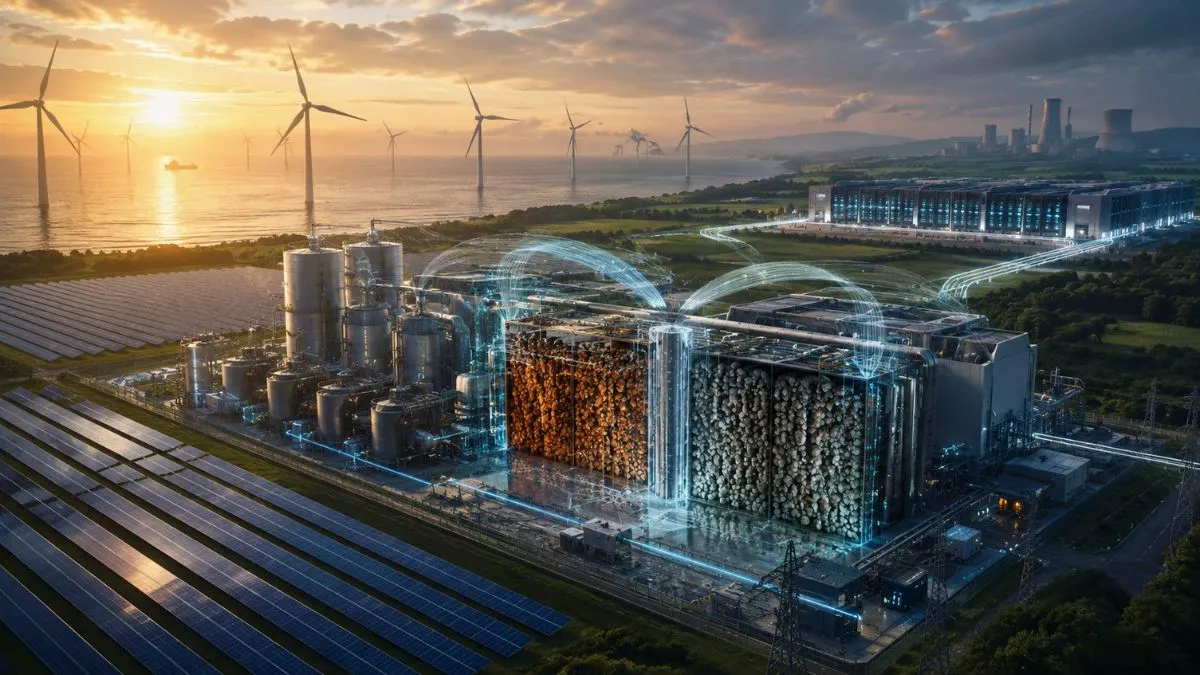
The batteries at the center of the round work differently from the lithium-ion cells that dominate today's grid storage market. Ore's design uses electrodes, water, and air rather than lithium and cobalt. Charging the battery runs electricity backward through the system to convert rust back into iron; discharging lets that iron rust again, releasing the stored energy in the process — the mechanism behind the "breathing battery" nickname. Because iron is abundant and doesn't need to be imported the way lithium and cobalt do, Ore says the batteries can be built entirely within Europe.
The headline figure is duration: Ore's batteries can store power for up to 100 hours, compared with the 4-to-12-hour range typical of most grid batteries in use today. At roughly one-tenth the cost of lithium-ion per the company, that combination of long duration and lower cost is the core of Ore's pitch.
Background: how does an iron-air battery actually work?
The battery pairs iron electrodes with air and water. Discharging is essentially a controlled rusting reaction — iron reacts with oxygen and releases the stored electrical energy as it does. Charging reverses that chemistry, using electricity to strip the oxygen back off and turn the rust into iron metal again, ready for another cycle. ⚠️ The raw source does not provide cycle-life, round-trip efficiency, or degradation figures, so those performance details aren't covered here.
Why It Matters
Why It Matters
Europe's renewable buildout has created a timing mismatch: wind and solar are cheap to generate but hard to store, and demand doesn't always line up with when the sun is shining or the wind is blowing. According to the source, Europe currently can't account for an estimated 72 TWh of wind and solar power each year simply because there's nowhere to put it during periods of high generation — power the source values at roughly $8 billion. Today, gas plants typically fill the gap during multi-day lulls in wind or sun.
Ore's CEO frames the company's real competitor not as other battery makers but as natural gas itself. If long-duration storage like Ore's can absorb that wasted renewable power and dispatch it days later, it could reduce utilities' reliance on gas turbines for grid backup and on curtailment payments to wind farms.
There's also an AI angle: global data center electricity use is projected to rise to 945 TWh by 2030, and AI workloads create demand spikes that utilities aren't well set up to absorb. The source frames multi-day storage as a way for data centers to run on renewables without outages, rather than needing constant gas backup.
The Numbers
Methodology & sourcing notes
All figures above come directly from the supplied source material: the $43M Series A, $61M cumulative funding, 100-hour storage duration, 4–12 hour typical range, 1 GWh Budget Thuis agreement, and Form Energy's $1.2B+ raised. The SVG bars are illustrative and proportioned to the stated figures rather than pulled from a precise dataset; no numbers outside the source were used.
Funding Landscape
⚠️ Flagged / Unverified
This is a private Series A funding round, not a public market event — the source contains no stock price, token price, or public sentiment data, so there is no "market reaction" in the trading sense to report.
What the source does provide is competitive context. Ore's $43 million round is modest next to US-based Form Energy, which has raised more than $1.2 billion at a $3.4 billion valuation and is building a West Virginia factory targeting 500 MW of iron-air production per year by 2028. In Europe, companies including iwell and Terralayr are also working on grid-scale storage, though the source notes they're focused on shorter-duration systems rather than Ore's 100-hour iron-air approach. The source frames Ore's smaller raise as sufficient to buy the company time to scale, rather than a signal of weaker investor confidence.
What's Next / Things to Watch
Ore Energy has laid out two milestones: reaching gigawatt-hour-scale production by 2028, and making iron-air storage a core part of European grid infrastructure by 2035. Near-term, its 1 GWh agreement with Budget Thuis and ongoing pilots with EDF are the concrete commercial signals to watch for progress updates. The broader question the source raises is whether utilities shift away from paying to curtail wind farms or firing up gas turbines during shortfalls, toward buying cheap surplus renewable power and storing it for days at a time — the shift Ore is betting its business on.
FAQs
What is a "rust battery"?
It's a nickname for Ore Energy's iron-air battery, which stores energy by letting iron rust (discharging) and reverses that reaction with electricity to turn rust back into iron (charging).
How much funding did Ore Energy raise?
$43 million in a Series A round, bringing its total funding to $61 million.
How long can Ore's batteries store energy?
Up to 100 hours, compared with 4 to 12 hours for most grid batteries currently in use.
How does this compare to Form Energy?
Form Energy, a US iron-air battery maker, has raised over $1.2 billion at a $3.4 billion valuation and is building a factory in West Virginia aimed at 500 MW of annual production by 2028 — a much larger scale of funding than Ore's round.
Who are Ore Energy's customers so far?
The source names a 1 GWh agreement with Dutch energy supplier Budget Thuis and ongoing pilots with French utility EDF.
Endnotes: ⚠️ The supplied source material did not include any external URLs or citation links to attribute here. Two related items were referenced by headline only ("June AI Raises $20M To Automate Enterprise AI Deployment" and "Base Power Raises $1B To Mass Produce Batteries for Homes") but no links were provided for either, so they are not included as sourced endnotes.
Investment disclaimer: The content reflects the author’s personal views and current market conditions. Please conduct your own research before investing in cryptocurrencies, as neither the author nor the publication is responsible for any financial losses.
Ad Disclosure: This site may feature sponsored content and affiliate links. All advertisements are clearly labeled, and ad partners have no influence over our editorial content.

Related Articles
XRP Price Prediction: AI Models See $4-$8 Target as Legal Overhang Lifts
ChatGPT AI predicts XRP could reach $4-$8 by end of 2026 as SEC lawsuit closure removes legal overhang, but current price at $1.02 suggests the harder test lies ahead.
Fireplace Is Extinguished: Prediction Market Terminal Shuts Down 195 Days After Launch
Prediction markets terminal Fireplace is shutting down 195 days after launch, giving users until Sept 30 to withdraw funds — even after raising $1.5M and building for Polymarket and Kalshi.

CLARITY Act Push, Another Strategy Bitcoin Sale, and a Warning About Invisible Quantum Attacks
A recap of today's crypto news: the White House's push to pass the CLARITY Act by September, Strategy's latest Bitcoin sale to fund a stock buyback, and a warning about undetectable quantum-computing attacks on crypto wallets.

Standard Chartered: LINK Could Climb 25x to $200 if Tokenized Assets Hit $4T by 2028
Standard Chartered forecasts LINK could rise 25-fold to $200 by 2030 as tokenized real-world assets scale to $4 trillion, citing Chainlink's dominant oracle market position.