

Brazil Imposes 24-Hour Crypto Transfer Holds to Combat Cross-Border Fraud
New central bank regulation targets transactions over $10,000 sent to foreign platforms and self-custody wallets, effective January 2027

By Jane Doe
Published on Aug 9, 2026
 Cryptorah
Quick Take
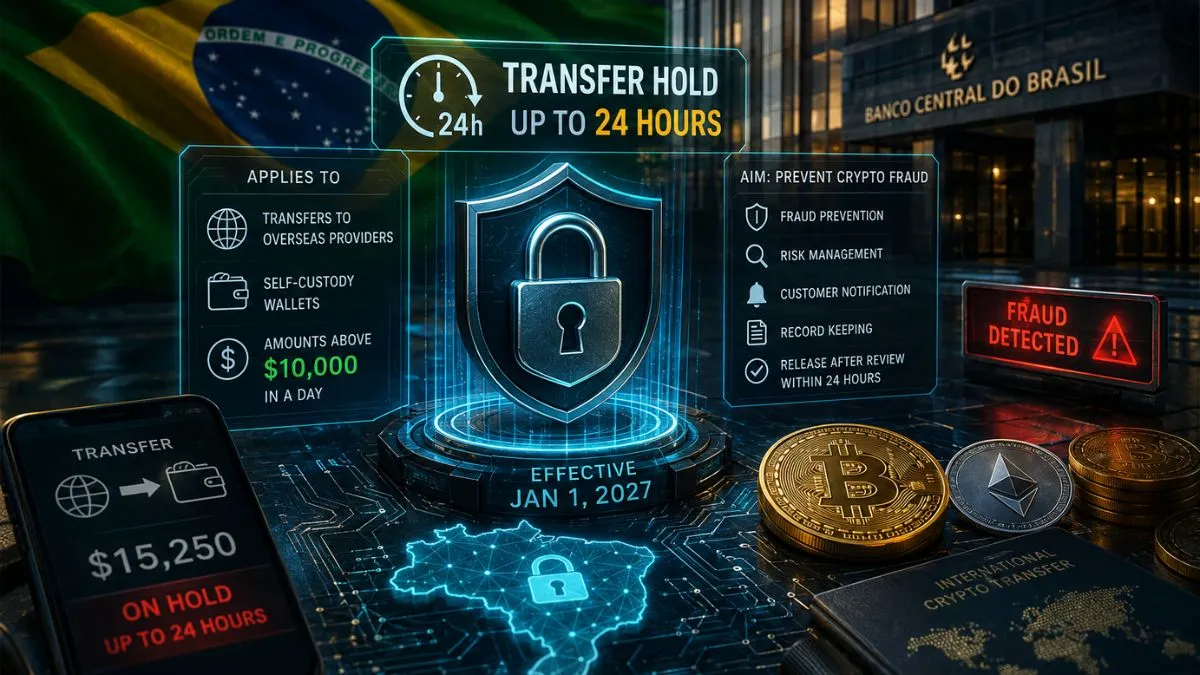
- Brazil's central bank will require virtual asset service providers to hold certain crypto transfers for up to 24 hours starting January 1, 2027
- The regulation applies to transfers exceeding $10,000 (single or daily cumulative) sent to overseas providers or self-custody wallets
- Providers must notify customers, maintain fraud records, and may release transfers early if risk assessments clear
- The move aligns Brazil with a growing international effort to slow crypto-facilitated scams that exploit digital assets' speed and borderless nature
What Happened
On Friday, the Banco Central do Brasil (BCB) announced a precautionary holding requirement for virtual asset service providers operating in the country. Beginning January 1, 2027, exchanges and other crypto platforms must pause certain outbound transfers for up to 24 hours before allowing them to complete.
The regulation specifically targets two transaction categories: first, any transfer above $10,000—whether as a single transaction or as the cumulative total of a customer's daily activity—destined for foreign platforms or self-custody wallets. Second, any other transfers that trigger red flags under a provider's internal risk-management policies, regardless of amount or destination.
During the hold period, VASPs must assess the transaction for fraud indicators. Providers may release funds before the full 24 hours elapse if their review concludes the transfer meets risk parameters established by the central bank. Throughout the process, platforms are required to notify affected customers and maintain detailed records of fraud incidents, attempted fraud, and any corrective measures taken.
Why It Matters
Key Implication: Brazil's regulation represents a structural shift in how Latin America's largest economy approaches crypto fraud prevention—moving from post-incident response to proactive transaction screening at the point of withdrawal.
The measure directly addresses a vulnerability inherent in cryptocurrency transactions: their irreversibility and speed. Traditional banking systems have long employed similar holds for suspicious wire transfers, but the crypto sector has historically prioritized frictionless, near-instant settlement. Scammers have exploited this design choice, using social engineering to convince victims to send funds that disappear across borders within minutes.
By inserting a mandatory cooling-off window for large and high-risk transfers, Brazil aims to create space for intervention—either by the platform's fraud team or by the customer themselves, who may realize they've been deceived once the initial urgency manufactured by a scammer dissipates.
The regulation also places Brazil among jurisdictions treating crypto platforms as financial intermediaries with affirmative obligations to protect users, rather than neutral software providers. This philosophical stance has significant implications for compliance costs, platform design, and user experience in Brazil's crypto market.
The Numbers
The $10,000 threshold applies in two scenarios: as a single transaction limit or as the sum of all transactions a customer initiates within a 24-hour period. This dual-trigger design prevents circumvention through transaction splitting—a common technique where fraudsters or money launderers break large transfers into smaller chunks to stay below reporting thresholds.
Technical Context: Why $10,000?
While the central bank announcement does not explain the rationale for the $10,000 threshold, it aligns with common anti-money laundering (AML) reporting thresholds used in many jurisdictions. The figure is high enough to exempt routine retail transactions while capturing transfers large enough to represent serious fraud risk or organized criminal activity. The choice also suggests regulators view amounts below this level as manageable risk within existing platform monitoring systems.
Global Context: Japan and Europe
Brazil's initiative follows a wave of anti-fraud measures introduced by regulators worldwide as crypto adoption has scaled and scam sophistication has grown.
Japan's Non-Binding Framework
Japan's Financial Services Agency and National Police Agency recently asked—but did not mandate—crypto exchanges to restrict withdrawals after customers deposit fiat currency or purchase digital assets. Japanese authorities also recommended that platforms require preregistration of withdrawal addresses, impose waiting periods before newly added addresses become active, and implement customer-specific withdrawal limits.
Additional safeguards proposed in Japan include phishing-resistant multifactor authentication, enhanced transaction monitoring, and verification that the name associated with a bank deposit matches the name on the corresponding crypto account.
| Jurisdiction | Binding Status | Key Mechanism |
|---|---|---|
| Brazil | Mandatory | 24-hour hold on transfers above $10,000 to foreign/self-custody destinations |
| Japan | Voluntary guidance | Withdrawal restrictions post-deposit; address preregistration; waiting periods |
| European Union | Licensing enforcement | Warnings about impersonation scams targeting users seeking MiCA-compliant providers |
A critical distinction separates Brazil's approach from Japan's: enforcement. While Japan's measures remain recommendations that exchanges may tailor to their own risk profiles and operational realities, Brazil's regulation carries the force of law. Providers operating in Brazil must comply or face potential sanctions from the central bank.
Europe's Impersonation Scam Wave
European regulators have issued warnings about a different fraud vector: criminals impersonating regulatory authorities and legitimate crypto companies. These scams have proliferated following the EU's Markets in Crypto-Assets (MiCA) licensing deadline, as users search for properly licensed service providers.
France's financial regulator reported cases involving fake websites designed to mimic legitimate platforms, while the European Securities and Markets Authority disclosed that scammers had misused the agency's own identity and logo in falsified documents to lend credibility to fraudulent schemes.
These impersonation scams exploit the information asymmetry created by new licensing regimes: users know they should verify a platform's regulatory status but may lack the technical sophistication to detect spoofed websites or forged compliance documents.
What's Next
Virtual asset service providers operating in Brazil now face a 16-month implementation window before the regulation takes effect. During this period, platforms will need to:
- Build or acquire transaction monitoring systems capable of tracking cumulative daily transfer volumes per customer
- Develop risk-scoring models that align with BCB parameters for early release of held transfers
- Design customer notification workflows for holds, including clear explanations and estimated resolution timelines
- Establish record-keeping infrastructure for fraud incident documentation and reporting
- Train compliance and customer service teams on the new protocols
The regulation's impact on user behavior remains an open question. Large holders accustomed to moving funds freely may perceive the holds as friction that undermines crypto's value proposition, potentially driving activity to peer-to-peer channels or decentralized exchanges that operate outside Brazilian regulatory reach. Alternatively, the measure may increase user confidence in licensed platforms, particularly among institutional participants and risk-averse retail investors.
Implementation period for VASPs to build compliance infrastructure
Regulation takes effect; mandatory holds begin
Market observation period to assess impact on fraud rates, user experience, and platform compliance costs
Observers will be watching for quantitative outcomes: whether fraud incident rates decline, whether legitimate users experience significant inconvenience, and whether the regulation creates competitive advantages for platforms with sophisticated risk-management capabilities over smaller competitors that struggle to meet compliance requirements.
Frequently Asked Questions
Does the 24-hour hold apply to all crypto transfers in Brazil?
No. The mandatory hold applies only to transfers exceeding $10,000 (single transaction or daily cumulative) sent to overseas platforms or self-custody wallets, plus any other transfers flagged by a provider's risk-management system. Domestic transfers below the threshold and those not triggering risk flags will proceed normally.
Can a transfer be released before the full 24 hours?
Yes. Providers may complete their fraud assessment and release a transfer early if it meets risk parameters established by the Banco Central do Brasil. The 24-hour window represents a maximum hold period, not a mandatory delay for all flagged transactions.
How does this compare to similar regulations in other countries?
Brazil's regulation is binding, unlike Japan's voluntary guidance to exchanges. Japan's framework emphasizes withdrawal restrictions after fiat deposits and address preregistration, while Brazil focuses on holds for large outbound transfers to foreign or self-custody destinations. European efforts currently center on combating impersonation scams rather than transaction holds.
What happens if a customer's transfer is held?
The VASP must notify the customer that the transfer is under review. The platform will conduct a fraud assessment using its risk-management protocols and BCB guidelines. If the transfer clears review, it will be released—potentially before 24 hours elapse. Customers must maintain records, as providers are required to document fraud incidents and corrective actions.
Will this regulation affect crypto prices or trading volume in Brazil?
The announcement does not include market impact data, as the regulation does not take effect until January 2027. Potential effects could include reduced withdrawal volume if users perceive holds as friction, or increased confidence in regulated platforms among institutional and risk-averse participants. Market outcomes will become observable after implementation.
Methodology & Sourcing Notes
This report is based entirely on the official announcement from the Banco Central do Brasil published on the referenced date, along with contextual information regarding parallel regulatory developments in Japan and the European Union as described in the source material. No external price data, trading volume figures, or market impact projections were available in the source content. Comparative analysis between jurisdictions is derived solely from the regulatory frameworks described in the announcement. No predictive claims about market reaction or future fraud statistics are made beyond what can be reasonably inferred from the stated regulatory objectives.
Investment disclaimer: The content reflects the author’s personal views and current market conditions. Please conduct your own research before investing in cryptocurrencies, as neither the author nor the publication is responsible for any financial losses.
Ad Disclosure: This site may feature sponsored content and affiliate links. All advertisements are clearly labeled, and ad partners have no influence over our editorial content.

Related Articles
XRP Price Prediction: AI Models See $4-$8 Target as Legal Overhang Lifts
ChatGPT AI predicts XRP could reach $4-$8 by end of 2026 as SEC lawsuit closure removes legal overhang, but current price at $1.02 suggests the harder test lies ahead.

Fireplace Is Extinguished: Prediction Market Terminal Shuts Down 195 Days After Launch
Prediction markets terminal Fireplace is shutting down 195 days after launch, giving users until Sept 30 to withdraw funds — even after raising $1.5M and building for Polymarket and Kalshi.

CLARITY Act Push, Another Strategy Bitcoin Sale, and a Warning About Invisible Quantum Attacks
A recap of today's crypto news: the White House's push to pass the CLARITY Act by September, Strategy's latest Bitcoin sale to fund a stock buyback, and a warning about undetectable quantum-computing attacks on crypto wallets.

Standard Chartered: LINK Could Climb 25x to $200 if Tokenized Assets Hit $4T by 2028
Standard Chartered forecasts LINK could rise 25-fold to $200 by 2030 as tokenized real-world assets scale to $4 trillion, citing Chainlink's dominant oracle market position.