

Antora Energy Secures $550M to Scale Thermal Battery Manufacturing for AI Infrastructure and Industrial Heat
Series C funding accelerates production of solid carbon thermal storage systems serving data centers and heavy industry, with 5 GWh South Dakota deployment completed in under 12 months

By Jane Doe
Published on Jul 31, 2026
 Cryptorah
Quick Take
- Antora Energy raised $550 million in Series C led by G2 Venture Partners and Eclipse to expand thermal battery manufacturing capacity
- Company will build second U.S. production facility to serve industrial sites, AI data centers, and utility-scale projects
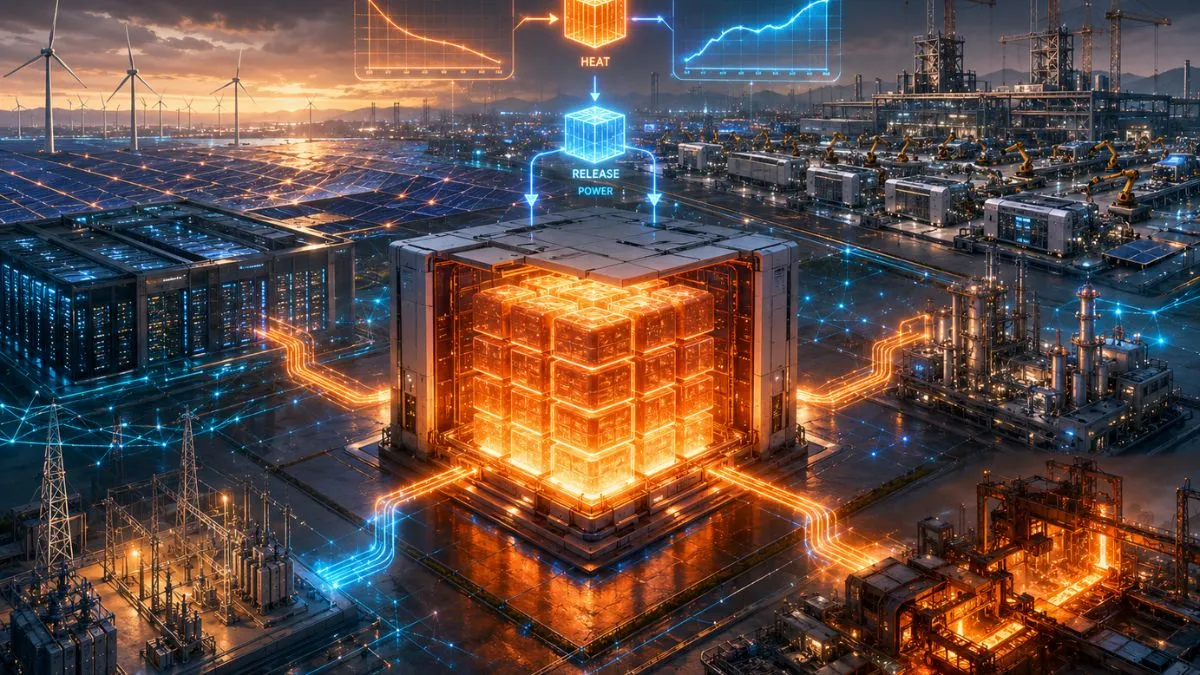
- Technology stores grid electricity as heat in insulated carbon blocks, later converted to industrial heat or electricity on demand
- Recent 5 gigawatt-hour South Dakota project went from construction to energy delivery in less than 12 months
What Happened
Antora Energy closed a $550 million Series C financing round to accelerate manufacturing expansion and commercial deployment of its thermal battery systems across the United States. G2 Venture Partners and Eclipse co-led the oversubscribed round, joined by Ribbit Capital, Salesforce Ventures, Activate Capital, StepStone Group, Liberty Mutual Strategic Ventures, Decarbonization Partners, Lowercarbon Capital, and individual investors including John Doerr and the Westly Group.
The capital will fund construction of a second domestic production facility, expand the company's existing San Jose manufacturing campus, and support utility-scale deployments targeting industrial customers and artificial intelligence data centers. Antora stated the expansion will create additional engineering, manufacturing, and construction jobs while strengthening domestic supply chains for energy storage components.
How Thermal Batteries Work
Antora's thermal battery systems store electrical energy by converting inexpensive grid electricity into heat within insulated solid carbon blocks. The stored thermal energy can later be discharged as industrial process heat or converted back to electricity when customers require power, functioning as a form of long-duration energy storage.
According to the company, the systems use common materials rather than rare earth minerals, addressing supply chain concerns that affect lithium-ion and other battery chemistries. The modular, factory-built design enables faster manufacturing cycles and shorter installation timelines compared to site-built energy infrastructure.
Target customers span multiple sectors: chemical manufacturers requiring process heat, food producers, steel plants, investor-owned utilities seeking grid-scale storage, and AI data centers with high electricity demand. Antora stated customers can reduce electricity costs by storing power during low-price periods and either using stored energy or selling electricity back to the grid during peak demand hours.
Technical Background: Why Thermal Storage?
Thermal energy storage systems convert electricity to heat (a thermodynamically efficient process) and store it in high-heat-capacity materials. Unlike electrochemical batteries that store energy in chemical bonds, thermal batteries store energy as sensible heat in solids. This approach can achieve longer discharge durations—hours to days—making it suitable for industrial applications requiring continuous heat or electricity beyond the typical 4-8 hour discharge window of lithium-ion systems.
The Numbers
South Dakota Deployment Timeline
Antora recently deployed what it describes as one of the world's largest battery storage projects: a 5-gigawatt-hour system in South Dakota that progressed from construction start to energy delivery in less than twelve months. The company positions this timeline as significantly faster than conventional energy infrastructure projects.
The San Jose manufacturing campus has expanded to a three-building facility that Antora describes as among the largest battery gigafactories in the United States. The new Series C funding will support replication of this manufacturing capability at a second domestic location.
Why It Matters
AI Data Centers Drive Energy Storage Demand
Artificial intelligence workloads are creating unprecedented electricity demand growth in U.S. data centers. According to reporting cited in the source material, companies increasingly seek reliable, deployable power sources that do not emit carbon, reducing dependence on fossil fuel generation. Antora's thermal batteries position the company at the intersection of two high-growth energy markets: AI infrastructure and industrial decarbonization.
The financing arrives as venture investment in clean technology has slowed sector-wide, making the oversubscribed round noteworthy. Investor demand signals continued confidence in long-duration energy storage technologies despite broader capital market headwinds.
For industrial customers, thermal batteries offer a pathway to decarbonize process heat—one of the hardest emissions sources to eliminate. Chemical plants, steel mills, and food processors typically burn natural gas or other fossil fuels for high-temperature heat. Antora's systems provide an alternative that can store renewable or low-cost grid electricity and discharge it as industrial heat without combustion.
For utilities and data center operators, the technology addresses a different challenge: providing reliable electricity during peak demand periods or when renewable generation is unavailable. The ability to store energy for extended durations (beyond the 4-8 hour window of most lithium-ion installations) makes thermal storage complementary to existing battery technologies rather than directly competitive.
Market Context
U.S. electricity demand is growing for the first time in decades, driven largely by data center expansion. AI model training and inference workloads require continuous power at scales that strain existing transmission infrastructure in many regions. The source material notes that data centers are a primary driver of this demand growth, creating urgency around deployable generation and storage capacity.
Antora positions its thermal batteries as offering faster deployment and lower cost than conventional battery systems, though direct cost comparisons were not provided in the source material. The company's claim rests on its use of common materials, modular factory production, and rapid on-site installation enabled by the pre-built design.
The energy storage market has seen growing interest in alternatives to lithium-ion chemistry for long-duration applications. Technologies under development or early deployment include flow batteries, compressed air storage, gravity-based systems, and various thermal storage approaches. Each targets different use cases based on discharge duration, power capacity, and cost structure.
Industry Context: Long-Duration Storage Landscape
Long-duration energy storage (LDES)—typically defined as systems that can discharge for 8+ hours—addresses a gap in the storage market. Lithium-ion batteries excel at 1-4 hour durations but become cost-prohibitive for longer discharge. Industrial heat applications and multi-day grid storage require different technologies. Thermal storage, pumped hydro, flow batteries, and mechanical storage systems compete in this space, each with distinct trade-offs in efficiency, cost, siting requirements, and discharge characteristics.
What's Next
Antora plans to use the Series C proceeds to accelerate commercial deployments across utility, industrial, and data center customers. The company will commission a second U.S. production facility to expand manufacturing capacity beyond the existing San Jose campus.
Key execution milestones to watch include:
- Site selection and construction timeline for the second manufacturing facility
- Announcement of new utility-scale or data center deployment contracts
- Capacity expansion at the San Jose gigafactory and production throughput metrics
- Partnerships with industrial customers in energy-intensive sectors (chemicals, steel, food processing)
- Economic performance data from the South Dakota 5 GWh project as it reaches operational maturity
The company's ability to scale manufacturing while maintaining installation speed will determine whether it can capture market share in both the industrial heat and utility storage segments. Competition will come from both established battery manufacturers expanding into long-duration storage and other emerging thermal and mechanical storage technologies.
Frequently Asked Questions
How does Antora's thermal battery differ from conventional lithium-ion batteries?
Antora's systems store energy as heat in solid carbon blocks rather than as electrochemical potential in lithium-ion cells. The technology uses common materials instead of rare earth minerals and can discharge energy as either industrial heat or electricity. This makes thermal batteries suited for longer-duration storage (hours to days) and industrial process heat applications where lithium-ion systems are less practical or cost-effective.
What does "5 gigawatt-hours" of storage capacity mean in practical terms?
A 5 GWh (5,000 MWh) system can deliver 1,000 megawatts of power for 5 hours, or 500 MW for 10 hours, or any other combination totaling 5,000 megawatt-hours of energy. For context, 5 GWh could power approximately 400,000 average U.S. homes for one hour, though the Antora system is designed for industrial and utility applications rather than residential use.
Why are AI data centers driving energy storage investment?
AI model training and inference operations require large amounts of continuous electricity. As data centers expand to support AI workloads, they strain local grids and require reliable backup power. Data center operators increasingly seek non-emitting power sources to meet sustainability commitments while ensuring uptime. Energy storage systems like Antora's thermal batteries can provide on-site generation capacity without fossil fuel combustion, addressing both reliability and decarbonization goals.
How do customers make money using thermal batteries?
According to Antora, customers can reduce costs by storing electricity when prices are low (typically during periods of high renewable generation or low demand) and then either using that stored energy themselves or selling electricity back to the grid during peak demand when prices are higher. Industrial customers can also replace natural gas or other fuels for process heat, potentially lowering operating costs while reducing emissions.
What is the significance of the "under 12 months" deployment timeline?
Traditional utility-scale energy projects—whether generation or storage—typically require 18-36 months or longer from construction start to commercial operation due to site preparation, equipment installation, interconnection approvals, and commissioning. Antora's ability to deploy a 5 GWh system in under 12 months suggests its modular, factory-built approach may reduce project timelines significantly, which matters for customers facing near-term capacity needs or developers seeking faster returns on capital.
Source Material
This report is based on the news article "Antora Energy Raises $550M To Expand Thermal Battery Production For AI And Industry" published by VentureBurn. All figures, quotes, and factual claims derive from that source material. References to "The Times" reporting on AI data center energy demand and Antora's statements about its technology appear in the original article.
Investment disclaimer: The content reflects the author’s personal views and current market conditions. Please conduct your own research before investing in cryptocurrencies, as neither the author nor the publication is responsible for any financial losses.
Ad Disclosure: This site may feature sponsored content and affiliate links. All advertisements are clearly labeled, and ad partners have no influence over our editorial content.

Related Articles
XRP Price Prediction: AI Models See $4-$8 Target as Legal Overhang Lifts
ChatGPT AI predicts XRP could reach $4-$8 by end of 2026 as SEC lawsuit closure removes legal overhang, but current price at $1.02 suggests the harder test lies ahead.

Fireplace Is Extinguished: Prediction Market Terminal Shuts Down 195 Days After Launch
Prediction markets terminal Fireplace is shutting down 195 days after launch, giving users until Sept 30 to withdraw funds — even after raising $1.5M and building for Polymarket and Kalshi.

CLARITY Act Push, Another Strategy Bitcoin Sale, and a Warning About Invisible Quantum Attacks
A recap of today's crypto news: the White House's push to pass the CLARITY Act by September, Strategy's latest Bitcoin sale to fund a stock buyback, and a warning about undetectable quantum-computing attacks on crypto wallets.

Standard Chartered: LINK Could Climb 25x to $200 if Tokenized Assets Hit $4T by 2028
Standard Chartered forecasts LINK could rise 25-fold to $200 by 2030 as tokenized real-world assets scale to $4 trillion, citing Chainlink's dominant oracle market position.