

ELIZAOS Token Officially Abandoned: Founder Walks Away After Lawsuit Drains Treasury
Shaw Walters declares token "finished" with no buyback, no treasury, and a 97% collapse—leaving holders to trade against nothing.

By Jane Doe
Published on Aug 6, 2026
 Cryptorah
Quick Take
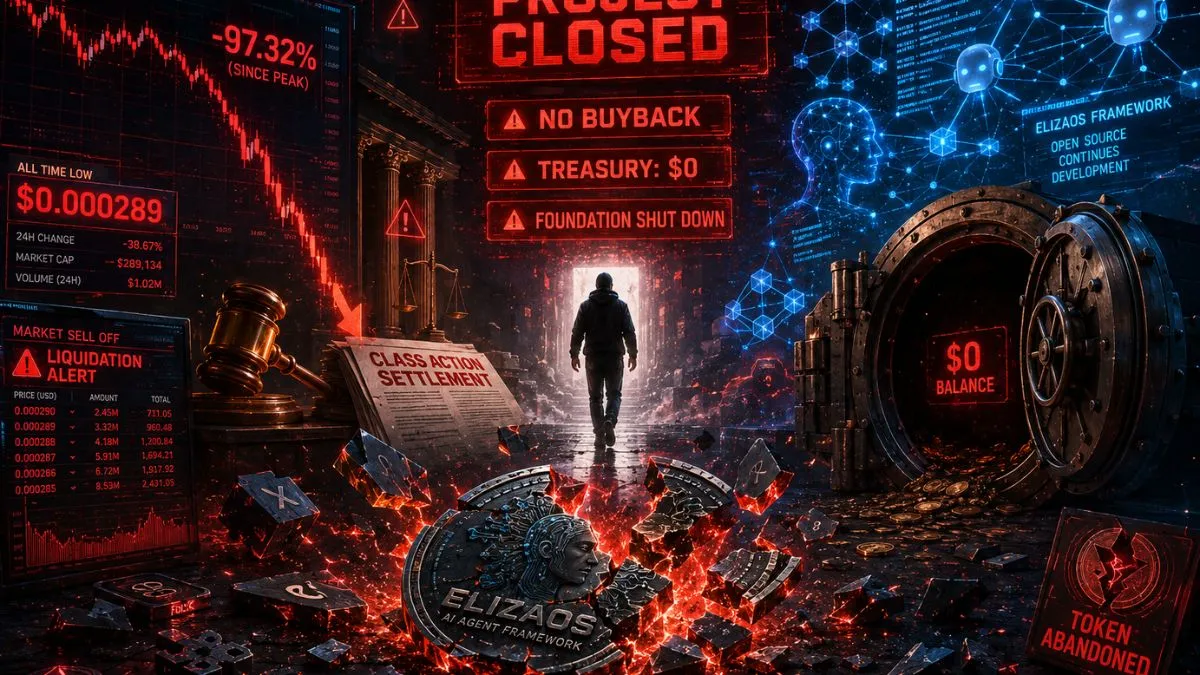
- Shaw Walters, founder of Eliza Labs, officially declared the ELIZAOS token dead on August 4, 2026, after a class-action lawsuit settlement exhausted the project's entire treasury.
- The token hit a record low near $0.000289, down more than 97% from its ecosystem peak valuation of roughly $2.4–2.5 billion.
- Walters stated there will be no buybacks, no supply reductions, no replacement token, and no ongoing support—holders are explicitly on their own.
- The open-source ElizaOS software framework will continue independent development, but without any associated token or financial incentive layer.
What Happened
On August 4, 2026, Shaw Walters published a lengthy statement on X (formerly Twitter) formally declaring the ELIZAOS token finished and the foundation in wind-down. The immediate catalyst was a settlement agreement with Burwick Law, which had filed a federal class-action lawsuit alleging misleading marketing, deceptive business practices, and investor harm related to the AI16Z project and its subsequent migration to ELIZAOS.
According to Walters, the Eliza Labs foundation lacked sufficient capital to fight the lawsuit in court, forcing a settlement that consumed every remaining dollar in the treasury. With zero funds left, Walters stated that the project could no longer provide any support infrastructure, developer incentives, or market-making operations for the token.
Critically, Walters made clear that no rescue plan exists. There will be no buyback program, no token supply reduction, and no replacement token. He confirmed ownership of the Eliza intellectual property and stated his intention to restart development under a new structure—one explicitly divorced from any tokenized asset tied to the Eliza brand.
Holders were told directly not to expect organized financial support from the project side going forward. The token remains listed on centralized exchanges, but trades purely on residual speculative interest with no fundamental backstop.
The Lawsuit Background
The Burwick Law class-action suit centered on allegations that the project engaged in misleading promotional activities and caused financial harm to investors who participated in the AI16Z ecosystem and its later ELIZAOS rebrand. While the full settlement terms were not disclosed in Walters' statement, the outcome was unambiguous: the foundation handed over its remaining assets and ceased operations.
This legal pressure was not the sole cause of ELIZAOS's collapse, but it served as the terminal event that formalized what had already become a structural deterioration.
Why It Matters
Industry Implications
The ELIZAOS collapse offers a rare, unambiguous case study in how token projects unravel when the founder-community contract breaks entirely. Unlike rug pulls or anonymous exit scams, this is a named founder explicitly walking away from a high-profile token after litigation, treasury depletion, and sustained underperformance.
The case raises uncomfortable questions about what residual token holders are trading when a founder publicly abandons a project with no replacement structure, no treasury, and no development roadmap tied to the token itself. In traditional equity markets, such a scenario would trigger delisting and formal bankruptcy proceedings. In crypto, the token continues to trade—often with surprising volatility—despite the absence of any fundamental value proposition.
ELIZAOS also exemplifies the risks inherent in aggressive token supply expansions during rebrands. The original AI16Z token launched during the late-2024 AI-agent speculation wave and achieved significant market attention. The migration to ELIZAOS involved a token swap that dramatically increased circulating supply, immediately pressuring price and diluting holder value. When combined with broader altcoin selling pressure and declining community confidence, the rebrand effectively set the stage for the project's eventual collapse.
The Software vs. Token Split
Walters drew a sharp distinction between the ELIZAOS token (dead) and the ElizaOS software framework (continuing). The framework is an open-source toolset that allows developers to build autonomous AI agents capable of interfacing with social platforms, blockchain networks, and digital wallets. Walters stated that development on the framework is accelerating, not stalling, and characterized the developer community as more productive without the distraction of token speculation.
Whether this software-only path proves viable long-term remains an open question. Many blockchain developer ecosystems rely on token incentives to bootstrap adoption, fund grants, and align community contributions. ElizaOS will now test whether a sufficiently compelling technical product can sustain itself on merit alone, without a financial layer to drive participation.
The Numbers
ELIZAOS Collapse: Peak to Present
Methodology Note: Valuation Figures
The $2.4–2.5 billion peak valuation figure refers to the combined ecosystem valuation across Eliza-styled tokens during the height of the AI-agent speculation cycle in late 2024, as stated in the source material. The current price of $0.000289 represents the record low reached following the August 4, 2026 abandonment announcement. No independent price data beyond what was provided in the source material has been used.
Market Reaction
The ELIZAOS token was already in severe distress well before Walters' final declaration. The project had shed more than 97% of its value from peak before the lawsuit settlement was announced, reflecting sustained selling pressure, loss of community confidence, and structural issues stemming from the token swap rebrand.
The August 4 announcement formalized what many participants had already concluded: the token had no viable path forward. Trading volume patterns and price behavior since the announcement were not detailed in available source material, but the token continues to be listed on centralized exchanges despite the complete absence of project-side support.
Broader AI-Agent Sector Context
The source material notes that broader altcoin selling pressure has negatively impacted the AI-agent token sector, but ELIZAOS was underperforming comparable tokens well before market-wide conditions worsened. The structural causes of its collapse—aggressive supply expansion during the rebrand, erosion of community trust, and ultimately legal settlement—were specific to the project rather than merely reflective of sector-wide trends.
The AI-agent token cohort from 2024 has seen multiple high-profile collapses and drawdowns, making ELIZAOS part of a broader pattern but distinguished by the explicit nature of the founder's abandonment and the complete depletion of the treasury through legal settlement.
What's Next
For Token Holders
Walters was explicit: there is no foundation, no treasury, no planned catalyst, and no buyback mechanism. Holders who continue to carry ELIZAOS are trading purely on speculative interest without any fundamental backstop. The project has no organized support structure, and Walters made clear he will not be launching a replacement token tied to the Eliza brand.
Residual trading will continue as long as exchanges maintain listings and liquidity providers remain active, but participants should understand they are operating in an environment with no project-side involvement or future development tied to token value.
For the ElizaOS Framework
The open-source ElizaOS software framework is being actively developed independently of the token. Walters stated that the team remains engaged and that development is accelerating. The critical test ahead is whether the framework can sustain developer adoption without a token-based incentive layer.
Many blockchain developer ecosystems rely on token grants, staking rewards, and financial alignment mechanisms to drive community contributions and ecosystem growth. ElizaOS will now attempt to prove that a sufficiently compelling technical product can thrive on merit alone. Whether this approach succeeds will determine the long-term legacy of the Eliza project, independent of the failed token.
Regulatory and Legal Precedent
The Burwick Law settlement and subsequent abandonment may set a precedent for how future class-action lawsuits against crypto projects proceed, particularly when projects lack the capital to mount extended legal defenses. The case also highlights the ambiguous legal status of token holders when a founder explicitly abandons a project: unlike traditional equity, there is no bankruptcy court, no liquidation trustee, and no formal process to wind down residual claims.
FAQs
What is ELIZAOS and what happened to it?
ELIZAOS was a Solana-based token associated with an AI-agent development framework called ElizaOS. The project originated as AI16Z in late 2024 during the AI-agent speculation boom, then rebranded and migrated to ELIZAOS through a token swap that expanded supply. On August 4, 2026, founder Shaw Walters declared the token finished after a class-action lawsuit settlement drained the project's entire treasury, leaving zero funds for ongoing support.
Why did Shaw Walters abandon the ELIZAOS token?
Walters abandoned the token after Burwick Law filed a federal class-action lawsuit alleging misleading marketing and investor harm. The Eliza Labs foundation lacked the capital to contest the lawsuit in court and settled by surrendering its remaining treasury. With zero funds left, Walters stated the project could no longer provide any token support infrastructure and officially declared it finished with no plans for buybacks, supply reductions, or a replacement token.
Is the ElizaOS software framework still being developed?
Yes. Walters drew a clear distinction between the token (dead) and the software (continuing). The open-source ElizaOS framework, which allows developers to build autonomous AI agents, will continue independent development without any associated token. Walters stated that the team remains active and that development is accelerating, though the framework will now operate without a financial incentive layer to drive adoption.
What does the 97% price collapse mean for current holders?
Current holders are trading a token that has no treasury, no project support, no planned catalysts, and a founder who has explicitly walked away. The token hit a record low near $0.000289 after falling more than 97% from its peak ecosystem valuation of roughly $2.4–2.5 billion. Residual trading continues on centralized exchanges purely on speculative interest, but there is no fundamental value proposition or organized support mechanism remaining.
Will Shaw Walters launch a new token to replace ELIZAOS?
No. Walters explicitly stated he owns the Eliza intellectual property and intends to restart development under a new structure, but that structure will have no token attached to the Eliza name. He told holders directly not to expect any replacement token or organized financial support from the project side.
Background: What Are AI-Agent Tokens?
AI-agent tokens emerged as a speculative category in late 2024, built around projects developing autonomous AI agents capable of interacting with blockchain networks, social platforms, and digital wallets. The thesis was that tokenized incentive layers would bootstrap developer adoption and ecosystem growth. Many projects in this cohort experienced extreme volatility, with valuations driven more by narrative speculation than product-market fit. ELIZAOS (originally AI16Z) was one of the most prominent names in this category before its collapse.
Investment disclaimer: The content reflects the author’s personal views and current market conditions. Please conduct your own research before investing in cryptocurrencies, as neither the author nor the publication is responsible for any financial losses.
Ad Disclosure: This site may feature sponsored content and affiliate links. All advertisements are clearly labeled, and ad partners have no influence over our editorial content.

Related Articles
XRP Price Prediction: AI Models See $4-$8 Target as Legal Overhang Lifts
ChatGPT AI predicts XRP could reach $4-$8 by end of 2026 as SEC lawsuit closure removes legal overhang, but current price at $1.02 suggests the harder test lies ahead.

Fireplace Is Extinguished: Prediction Market Terminal Shuts Down 195 Days After Launch
Prediction markets terminal Fireplace is shutting down 195 days after launch, giving users until Sept 30 to withdraw funds — even after raising $1.5M and building for Polymarket and Kalshi.

CLARITY Act Push, Another Strategy Bitcoin Sale, and a Warning About Invisible Quantum Attacks
A recap of today's crypto news: the White House's push to pass the CLARITY Act by September, Strategy's latest Bitcoin sale to fund a stock buyback, and a warning about undetectable quantum-computing attacks on crypto wallets.

Standard Chartered: LINK Could Climb 25x to $200 if Tokenized Assets Hit $4T by 2028
Standard Chartered forecasts LINK could rise 25-fold to $200 by 2030 as tokenized real-world assets scale to $4 trillion, citing Chainlink's dominant oracle market position.