

China Accelerates Gold Reserves with Largest Monthly Purchase in Three Years
Beijing acquired 20 tons in July as central banks globally return to bullion, pushing gold up 8% while Bitcoin struggles

By Jane Doe
Published on Aug 9, 2026
 Cryptorah
Quick Take
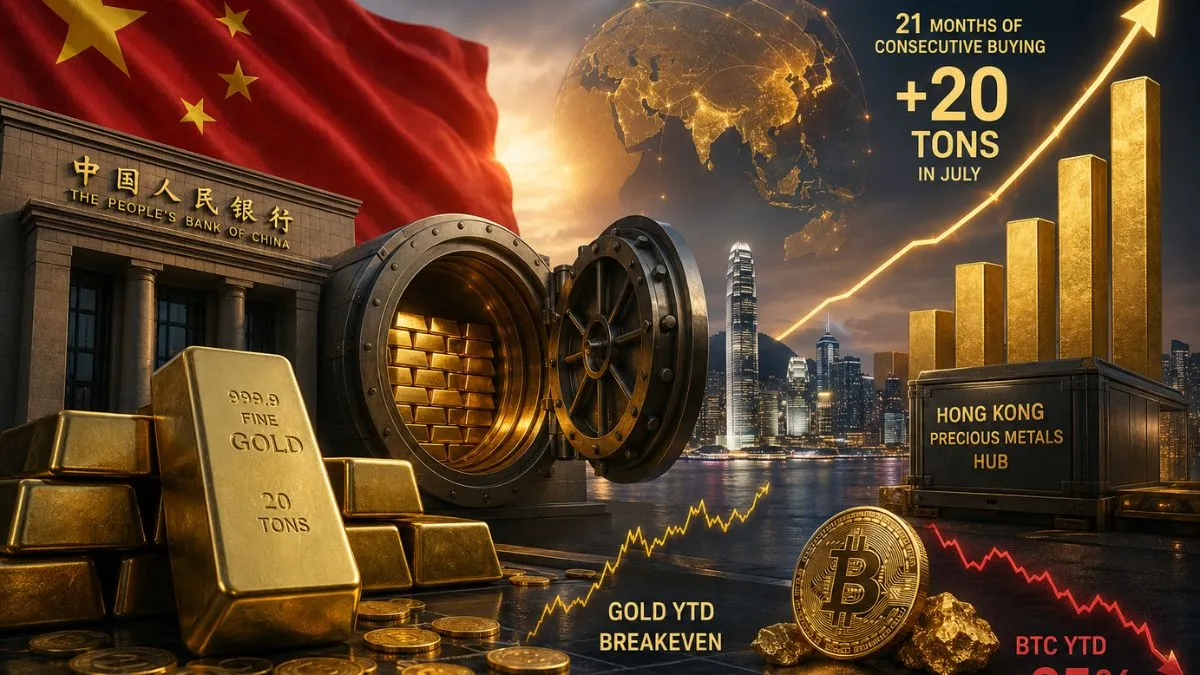
- People's Bank of China bought approximately 20 tons of gold in July 2026, the largest single-month purchase since October 2023
- China's buying streak has extended to 21 consecutive months; reserves now exceed 76 million ounces worth over $306 billion
- Global central banks purchased a record 289 tonnes in Q2 2026, up 74% year-over-year
- Gold rebounded 8% in one week to $4,342/oz, returning to breakeven YTD, while Bitcoin remains down 25% at $65,000
What Happened
The People's Bank of China significantly ramped up its gold accumulation in July 2026, purchasing approximately 640,000 troy ounces—roughly 20 metric tons—according to data from The Kobeissi Letter. This marks Beijing's largest single-month acquisition since October 2023 and extends an unbroken buying streak to 21 consecutive months.
China's total gold reserves climbed from just under 75.5 million ounces at the end of June to over 76 million ounces by the end of July. At current prices, the country's gold stockpile is valued at more than $306 billion, making it one of the world's largest state-held reserves of the precious metal.
The July purchase represents a dramatic acceleration in Beijing's acquisition pace. In March 2026, China added only 160,000 ounces. That figure grew progressively over subsequent months, with June's 480,000-ounce purchase already marking the biggest monthly addition in nearly three years—only to be surpassed by July's even larger haul.
Beyond accumulation, China is strategically relocating a substantial portion of its gold reserves from London vaults to Hong Kong. This move supports the city's ambition to become a major global hub for precious metal trading and pricing. Analysts at The Kobeissi Letter noted that Hong Kong is launching a new gold-clearing system designed to enhance its role in international gold markets.
Global Central Bank Trend
China is not alone in its renewed focus on gold. The World Gold Council reported that central banks worldwide purchased a record 289 tonnes of gold during the second quarter of 2026, representing a 74% increase compared to the same period in 2025. This surge signals a broader institutional pivot back to traditional safe-haven assets amid global economic uncertainty.
Background: China's Crypto Policy
While aggressively accumulating gold, China has maintained strict prohibitions on cryptocurrency activities. Earlier in 2026, Beijing reaffirmed that all digital asset-related business activities remain illegal within its borders. The government has expanded scrutiny to include stablecoins and real-world asset tokenization, reinforcing its stance that state-controlled assets—not decentralized cryptocurrencies—are the preferred reserve instruments.
Why It Matters
Key Implication: China's accelerating gold purchases and the record global central bank demand signal a fundamental shift in institutional reserve strategies. As geopolitical tensions persist and monetary policy uncertainty continues, central banks are diversifying away from traditional fiat-denominated assets and returning to tangible stores of value.
The magnitude and consistency of China's purchases underscore a deliberate strategy to reduce dependence on dollar-denominated reserves and hedge against currency volatility. With 21 consecutive months of buying, Beijing is demonstrating long-term commitment rather than opportunistic trading.
For cryptocurrency markets, the contrast is stark. While proponents have long positioned Bitcoin as "digital gold," the actual performance divergence in 2026 challenges that narrative. Institutional capital—especially sovereign wealth and central bank reserves—continues to favor physical bullion over crypto assets, despite Bitcoin's portability and divisibility advantages.
Hong Kong's emergence as a gold trading hub also has broader implications for Asia's financial architecture. By building infrastructure for physical gold settlement and pricing, the region is creating alternatives to Western-dominated commodity markets, potentially reshaping how global gold prices are discovered and traded.
The Numbers
China's Accelerating Accumulation
| Month (2026) | Ounces Purchased | Metric Tons (approx.) |
|---|---|---|
| March | 160,000 | ~5 tons |
| June | 480,000 | ~15 tons |
| July | 640,000 | ~20 tons |
Global Central Bank Purchases
Source: World Gold Council. Q2 2026 purchases represent a 74% year-over-year increase.
Market Reaction
Gold's price trajectory over recent months has been volatile. The precious metal reached an all-time high of $5,600 per ounce before entering a steep decline that saw it fall to just under $4,000—a drop of nearly 30% from peak to trough.
However, the surge in central bank buying helped arrest that decline. Over the past week, gold rebounded by approximately 8%, closing at $4,342 per ounce. This recovery brought the metal back to roughly breakeven on a year-to-date basis for 2026.
The Bitcoin Comparison
The contrast with Bitcoin has been pronounced. While gold has stabilized and returned to flat YTD performance, Bitcoin continues to trade at $65,000—down more than 25% since the beginning of 2026. This divergence undermines the "digital gold" narrative that has been central to Bitcoin's institutional adoption thesis.
Gold returned to breakeven after recent 8% rebound; Bitcoin remains down 25% YTD at $65,000.
Methodology Note
Performance figures are based on the data provided in the source material. Gold's all-time high of $5,600/oz, subsequent decline to near $4,000, and recovery to $4,342 are as reported. Bitcoin's current price of $65,000 and 25% YTD decline are likewise from the source. No additional market data sources were consulted.
What's Next
Several developments will be worth monitoring in the coming months:
China's Continued Accumulation
Given the accelerating pace—from 160,000 ounces in March to 640,000 in July—observers will watch whether Beijing maintains or further increases its monthly purchases. Any pause or reduction in buying could signal a shift in reserve strategy or suggest China has reached a target allocation.
Hong Kong's Gold Infrastructure
The rollout of Hong Kong's new gold-clearing system represents a structural change in global commodity markets. If successful, it could shift pricing power eastward and reduce London's historical dominance in gold trading. The extent to which international banks and traders adopt the new infrastructure will determine its long-term impact.
Central Bank Behavior
The record Q2 2026 purchasing by global central banks raises the question of whether this represents a temporary reallocation or a sustained multi-year trend. Sustained demand at current levels could place a firm floor under gold prices, while any deceleration might allow for renewed volatility.
Crypto vs. Gold Narrative
Bitcoin's underperformance relative to gold in 2026 challenges the digital gold thesis at a time when institutional adoption was expected to accelerate. Whether crypto markets can reclaim momentum—or whether traditional safe havens continue to outperform—will shape asset allocation strategies for institutional portfolios going forward.
FAQs
Why is China buying so much gold?
China is diversifying its foreign exchange reserves away from dollar-denominated assets. Accumulating gold provides a hedge against currency volatility, geopolitical risk, and inflation. The 21-month buying streak suggests a strategic, long-term reserve rebalancing rather than short-term speculation.
How does China's gold purchase affect global gold prices?
Large-scale, sustained buying by a major central bank creates consistent demand that can support or elevate prices. The recent 8% rebound in gold occurred during a period of record central bank purchases, including China's largest monthly acquisition in nearly three years. While correlation doesn't prove causation, institutional demand of this magnitude typically exerts upward pressure on prices.
Why is gold outperforming Bitcoin in 2026?
Gold has returned to breakeven YTD after a recent rebound, while Bitcoin remains down 25%. Several factors may explain this divergence: central banks and sovereign wealth funds favor tangible, historically proven stores of value; regulatory uncertainty continues to weigh on crypto markets; and macroeconomic conditions (geopolitical tensions, monetary policy shifts) have driven institutional capital toward traditional safe havens.
What is Hong Kong's new gold-clearing system?
Hong Kong is launching infrastructure designed to facilitate gold trading, settlement, and pricing within Asia. The system aims to make Hong Kong a global hub for physical gold transactions, offering an alternative to London-based clearing. China's relocation of reserves from London to Hong Kong supports this initiative and could reshape where and how international gold trading occurs.
Are other central banks also buying gold?
Yes. According to the World Gold Council, central banks globally purchased a record 289 tonnes of gold in Q2 2026, a 74% increase compared to Q2 2025. This indicates a broad, coordinated shift among monetary authorities toward increasing gold reserves as part of diversified reserve management strategies.
Sources
Data and figures in this report are derived exclusively from the provided source material, which cited The Kobeissi Letter for China's specific purchase data and the World Gold Council for global central bank statistics. No external or supplementary sources were consulted. All price figures, reserve totals, and purchase volumes reflect information as presented in the original content.
Investment disclaimer: The content reflects the author’s personal views and current market conditions. Please conduct your own research before investing in cryptocurrencies, as neither the author nor the publication is responsible for any financial losses.
Ad Disclosure: This site may feature sponsored content and affiliate links. All advertisements are clearly labeled, and ad partners have no influence over our editorial content.

Related Articles
XRP Price Prediction: AI Models See $4-$8 Target as Legal Overhang Lifts
ChatGPT AI predicts XRP could reach $4-$8 by end of 2026 as SEC lawsuit closure removes legal overhang, but current price at $1.02 suggests the harder test lies ahead.

Fireplace Is Extinguished: Prediction Market Terminal Shuts Down 195 Days After Launch
Prediction markets terminal Fireplace is shutting down 195 days after launch, giving users until Sept 30 to withdraw funds — even after raising $1.5M and building for Polymarket and Kalshi.

CLARITY Act Push, Another Strategy Bitcoin Sale, and a Warning About Invisible Quantum Attacks
A recap of today's crypto news: the White House's push to pass the CLARITY Act by September, Strategy's latest Bitcoin sale to fund a stock buyback, and a warning about undetectable quantum-computing attacks on crypto wallets.

Standard Chartered: LINK Could Climb 25x to $200 if Tokenized Assets Hit $4T by 2028
Standard Chartered forecasts LINK could rise 25-fold to $200 by 2030 as tokenized real-world assets scale to $4 trillion, citing Chainlink's dominant oracle market position.